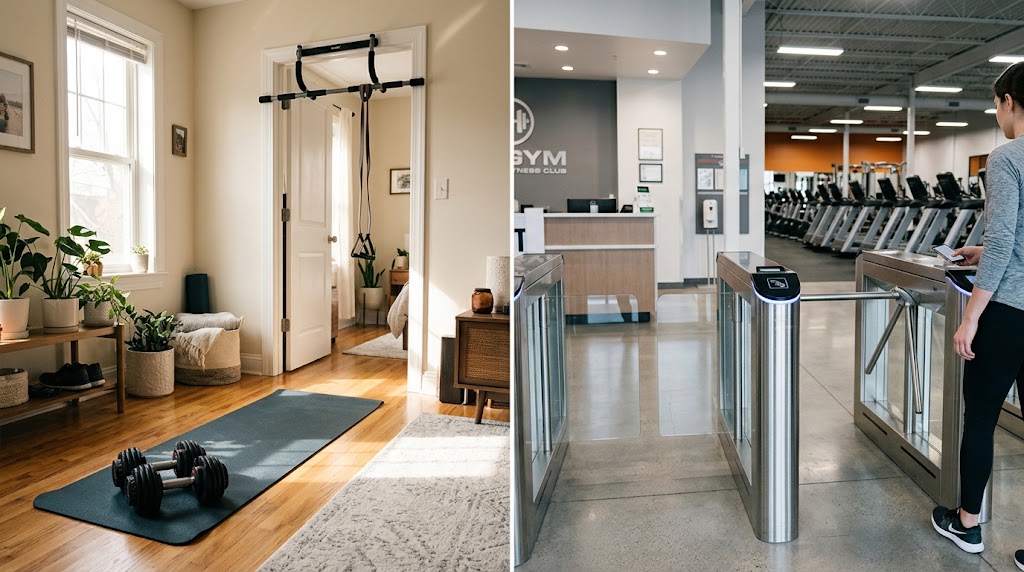
The real cost of a gym membership
The advertised price of a gym membership is not the actual price. A "basic" membership at $30/month becomes $40/month after taxes, enrollment fees amortised over 12 months, and annual maintenance fees. A "premium" membership at $60/month that includes classes and towel service runs closer to $75/month all-in.
Over 5 years, a $40/month membership costs $2,400. Over 10 years, $4,800. And that assumes no price increases, which every gym implements. The average gym membership price increase is 5 to 8 percent annually. Your $40/month membership is $52 to $59/month in year 5.
Then add the invisible costs: driving to and from the gym (fuel, time, wear on your car), parking if applicable, gym bag maintenance, and the single largest invisible cost of all: time. A 45-minute gym workout takes 90 to 120 minutes door to door when you factor in the drive, changing, waiting for equipment, and the drive home.
The real cost of a home gym
Budget home gym ($150 to $300)
| Item | Cost |
|---|---|
| Pull-up bar | $25 to $40 |
| Resistance bands (set of 5) | $15 to $30 |
| Foam tiles (24 sq ft) | $20 to $30 |
| Ab roller | $10 to $15 |
| Jump rope | $10 to $20 |
| Suspension trainer | $25 to $100 |
| Yoga mat | $15 to $30 |
| Total | $120 to $265 |
This setup covers pulling, pushing, core, cardio, and flexibility. It fits in a closet. It pays for itself in 3 to 6 months against a gym membership. And it lasts 5 to 10 years with zero ongoing cost.
Mid-range home gym ($500 to $1,200)
| Item | Cost |
|---|---|
| Adjustable dumbbells (5 to 52.5 lbs) | $250 to $400 |
| Flat/incline bench | $80 to $200 |
| Pull-up bar (wall-mount) | $40 to $80 |
| Rubber flooring (48 sq ft) | $75 to $150 |
| Kettlebell (35 lbs) | $40 to $60 |
| Resistance bands | $20 to $30 |
| Total | $505 to $920 |
This is the sweet spot for most home lifters. Adjustable dumbbells replace a full dumbbell rack. A bench opens up incline press, chest-supported rows, and step-ups. This setup handles any programme that does not require a barbell, which covers the vast majority of recreational lifters. Payback period: 12 to 24 months.
Full home gym ($2,000 to $5,000)
| Item | Cost |
|---|---|
| Power rack or squat stand | $300 to $800 |
| Olympic barbell | $150 to $300 |
| Bumper plate set (300 lbs) | $400 to $800 |
| Adjustable bench | $150 to $300 |
| Cable attachment | $200 to $500 |
| Rubber flooring + crash pads | $200 to $400 |
| Accessories (bands, handles, clips) | $100 to $200 |
| Total | $1,500 to $3,300 |
This replaces a commercial gym entirely. Squat, bench, deadlift, overhead press, rows, cables, and accessories. Payback period: 3 to 7 years against a premium membership. But the time savings (zero commute, zero waiting for equipment, train whenever you want) accelerates the value beyond the dollar comparison.
The time comparison
Assume you train 4 days per week. A gym workout takes 90 minutes door to door (15 min drive each way, 60 min training). A home workout takes 50 minutes (5 min setup, 45 min training). That is a 40-minute savings per session, or 160 minutes per week, or roughly 139 hours per year.
Value your time at even $15/hour (below minimum wage in most cities), and those 139 hours are worth $2,085 per year. That alone exceeds the cost of a mid-range home gym in year one. This is the argument that gym-vs-home cost calculators almost always leave out.
What a gym provides that home cannot
Social accountability: Working out with others increases consistency. If you show up because your training partner expects you, that has real value. At home, you have to motivate yourself.
Equipment variety: A commercial gym has machines you will never buy: leg press, cable crossover, Smith machine, speciality bars. If your programme requires this variety, a gym membership makes sense.
Coaching: Personal trainers, group classes, and the ability to ask someone for a spot. Beginners benefit from in-person instruction that no YouTube video fully replaces.
Separation of space: Some people train better when they leave their home. The physical act of going somewhere signals to the brain that it is time to work. If you struggle with motivation at home, the commute to a gym may be worth the time cost.
The hybrid approach
You do not have to choose one. Many people maintain a basic home gym for daily training (bodyweight, dumbbells, cardio) and keep a budget gym membership ($10 to $20/month) for weekly barbell sessions or specific machines. This gives you the time efficiency of home training on most days and the equipment access of a gym when you need it.
The budget gym membership also solves the motivation problem. On days when you cannot train at home, you have a backup. The cost of a basic membership plus a mid-range home gym is still less than a premium membership alone over 3 years.
Bottom line
A budget home gym pays for itself in 3 to 6 months. A mid-range setup pays for itself in 1 to 2 years. A full home gym pays for itself in 3 to 7 years. All three save 100 or more hours per year in commute time. Unless you specifically need gym-only equipment, social accountability, or in-person coaching, a home gym is the better financial and practical choice for long-term fitness.