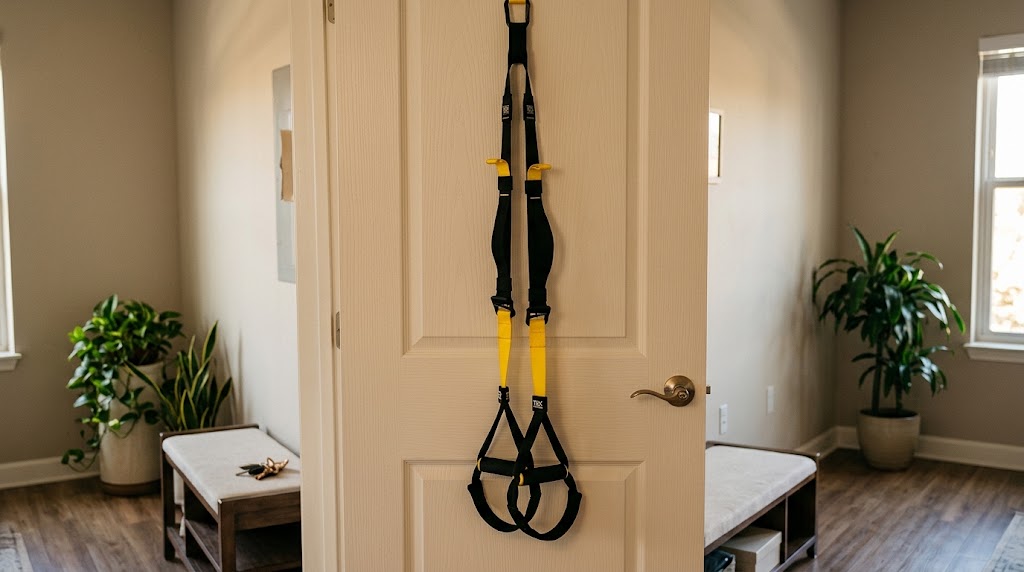
What a suspension trainer actually does
A suspension trainer is two adjustable straps with handles and foot cradles, anchored to a door, ceiling, or beam. You use your body weight against gravity, and the angle of your body controls the resistance. Stand nearly upright and a row is easy. Lean back to 45 degrees and it becomes moderate. Get horizontal and you are working at near body weight.
This adjustable difficulty is what makes suspension training useful for everyone from rehabilitation patients to elite athletes. The same tool, the same anchor point, the same exercises. Only the angle changes.
TRX vs the alternatives
TRX (the original)
TRX invented the category for the US Navy SEALs in 2004. The TRX GO is their travel-friendly model: weighs under 1 lb, packs into a mesh bag the size of a paperback, and anchors to any door with the included door anchor. It handles up to 350 lbs and is built to outlast years of daily use.
The TRX Pro3 is their gym-grade model: locking carabiners, Kevlar-reinforced stitching, rubber handles with tactical knurling. It is heavier, more durable, and about twice the price. If you train daily and hard, the Pro3 is worth the upgrade. For three to four sessions per week at home, the GO is more than sufficient.
Budget alternatives
Dozens of suspension trainers on Amazon cost $20 to $40. They look like TRX straps and function similarly. The differences show up in stitching quality, buckle durability, and handle grip. After six months of heavy use, cheap buckles can slip under load, which is not just annoying but dangerous when your feet are in the cradles and your hands are on the floor.
The TRX All-in-One system sits between the GO and Pro3 in both price and features. It includes a door anchor, a suspension anchor for outdoor use, and access to the TRX app with guided workouts. For most home users, this is the best value in the lineup.
Anchoring options
Door anchor
A padded loop that wedges between the top of a door and its frame. Close the door and the strap hangs from the top hinge side. Works with any solid-core door (not hollow-core). This is the most common home setup and the one included with every TRX package.
Limitations: you cannot do exercises that pull the door open (the door must be closed toward you). You lose access to that door during your workout. And hollow-core doors can crack under repeated load.
Ceiling mount
A steel bracket bolted into a ceiling joist or beam. The most versatile anchor because you can move 360 degrees around it. Requires a drill, a stud finder, and lag bolts rated for your weight. Permanent installation, so renters may need landlord permission.
Outdoor: tree, beam, or pull-up bar
Wrap the suspension anchor around any sturdy horizontal structure. Trees, park structures, exposed beams in a garage, or an existing pull-up bar. The TRX suspension anchor is a loop of heavy-duty nylon that cinches tight and distributes load evenly without damaging the surface.
Essential exercises for a full-body routine
Upper body
Rows: Face the anchor, lean back, pull yourself up. The staple back exercise. Adjust difficulty by changing your foot position closer to or farther from the anchor.
Chest press: Face away from the anchor, hands in handles, lean forward and press. Same mechanics as a push-up but with adjustable difficulty and greater range of motion.
Bicep curls and tricep press: Single-arm or double-arm, standing. Light resistance but high time under tension.
Lower body
Pistol squats: Hold the handles for balance while lowering on one leg. Suspension straps make pistol squats accessible to people who cannot do them unassisted.
Hamstring curls: Lie on your back, heels in the foot cradles, curl your heels toward your glutes. One of the few bodyweight exercises that isolates the hamstrings effectively.
Bulgarian split squats: Rear foot in a cradle, front foot on the ground. Deep single-leg work that builds stability and strength simultaneously.
Core
Plank: Feet in cradles, hands on the floor. The instability of the straps forces your core to stabilise constantly.
Pike: From plank position, hike your hips to the ceiling. Targets the entire anterior chain.
Mountain climbers: Feet in cradles, drive knees to chest alternately. Combines core work with cardio.
Bottom line
A suspension trainer is the most versatile single piece of equipment for a small-space home gym. It trains every major muscle group, adjusts from beginner to advanced by changing your body angle, and stores in a drawer. The TRX brand commands a premium, but the build quality justifies the price if you plan to use it regularly. Budget straps work for casual use but watch the buckles.