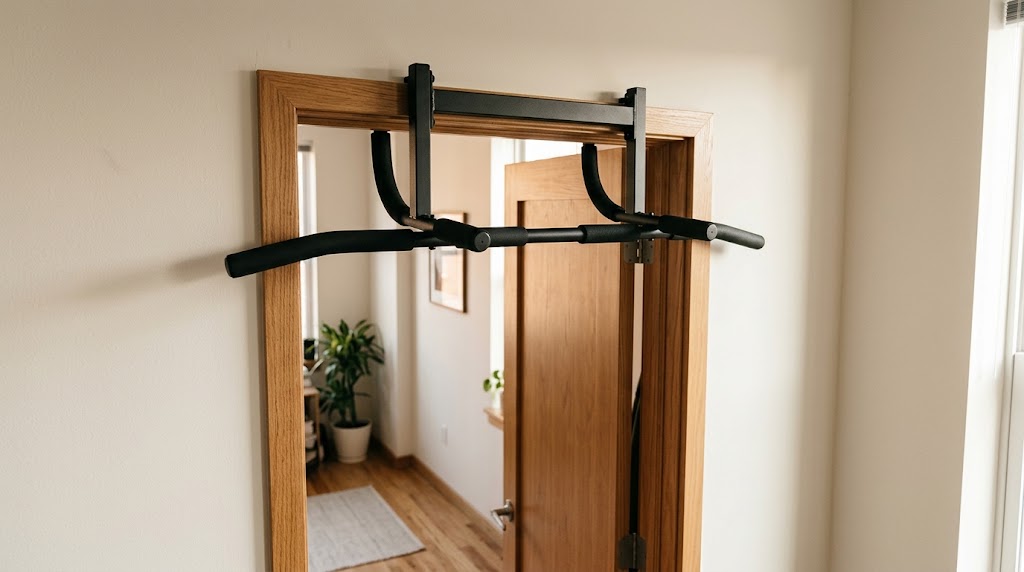
Why a pull-up bar belongs in every home gym
The pull-up is the single most effective bodyweight exercise for your back, biceps, and grip. It requires zero floor space, builds functional strength that transfers to climbing, carrying, and everyday lifting, and the equipment costs less than a month of gym membership. A door frame bar turns any standard doorway into a pull station in under 60 seconds.
The catch is that not all door frame bars work in all door frames. Trim width, door casing depth, and wall construction all matter. Get the wrong bar and you are looking at scuffed paint, stripped screws, or a bar that pops off mid-rep. Here is how to match the right bar to your doorway.
Three types of door frame pull-up bars
Leverage-mounted (no screws)
These bars hook over the door frame using your body weight as leverage. A padded bracket presses against the wall above the door while the bar extends into the frame. Installation takes 10 seconds, removal takes five. The trade-off is that they rely entirely on the door trim being solid wood and at least 2 inches deep. Thin or decorative trim may crack.
The Iron Age Pull-Up Bar uses a patented smart hook angle that distributes weight more evenly across the frame. It holds up to 300 lbs and fits door frames 24 to 36 inches wide. The curved grip positions let you do wide grip, close grip, and neutral grip pull-ups from one bar.
Telescoping (tension-mounted)
A straight bar that extends and locks between two walls using spring tension and rubber end caps. Works in doorways, hallways, or between any two parallel walls. The benefit is simplicity and a clean look. The risk is slipping if the rubber caps wear down or the walls are smooth plaster. Most tension bars hold 200 to 250 lbs, which limits options for heavier lifters or weighted pull-ups.
Screw-mounted
Bolted directly into the door frame or wall studs. The most secure option by a wide margin. Holds 400 lbs or more, never slips, and handles kipping, muscle-ups, and hanging leg raises without flex. The downside is permanent holes in your frame and a bar that does not come down between sessions. If you own your home, this is the best option. If you rent, check your lease first.
What to check before you buy
Door frame width
Standard interior doors in the US are 24 to 36 inches wide. Most leverage bars fit this range. Measure at the inside of the trim, not the wall opening. If your frame is wider than 36 inches (common in older homes), you need a telescoping bar rated for that span.
Trim and casing
Leverage bars need a casing at least 2 to 3 inches deep to hook onto. Measure from the front edge of the trim to the wall. Modern minimalist trim (flat stock, 1 inch deep) may not provide enough ledge. In that case, a tension bar or screw-mount is safer.
Weight capacity
Your body weight plus any added weight. If you weigh 200 lbs and plan to add a 45 lb weight vest eventually, you need a bar rated for at least 250 lbs. Build in a safety margin of 20 to 25 percent above your working weight.
Grip variety
A straight bar gives you overhand and underhand grip. A multi-grip bar adds neutral (palms facing each other) and wide positions. More grips means more exercise variety from the same bar. If you are only going to own one upper-body pulling tool, get the one with the most grip options.
Three bars worth considering
| Feature | Iron Age Smart Hook | Garren Fitness Maximiza | Iron Age Over-Door |
|---|---|---|---|
| Mount type | Leverage | Leverage | Leverage |
| Weight limit | 300 lbs | 300 lbs | 300 lbs |
| Door width | 24 to 36 in | 24 to 36 in | 26 to 39 in |
| Grip positions | 6 | 3 | 5 |
| Foam grips | Yes | Yes | Yes |
The Iron Age Smart Hook offers the most grip variety and a redesigned hook system. The Garren Fitness Maximiza keeps things simple with three solid grip positions and a proven track record. The Iron Age Over-Door model extends to wider frames, which makes it useful for older homes with non-standard openings.
Programming pull-ups in a small space
The beauty of a door frame bar is that it is always there. Every time you walk past, you can do a set. This approach, called "greasing the groove," is one of the most effective ways to increase your pull-up numbers without dedicated training sessions.
Start with whatever you can do: if that is one rep, do one rep five to eight times throughout the day. If you cannot do a full pull-up yet, do negative reps (jump to the top position and lower yourself slowly over 3 to 5 seconds). Within four to six weeks of consistent practice, most people add 3 to 5 reps to their max set.
Pair pull-ups with push-ups for a complete upper-body routine. Alternate sets with minimal rest. This superset approach saves time, keeps your heart rate elevated, and builds balanced pushing and pulling strength without needing a single piece of floor equipment beyond a resistance band.
Bottom line
A door frame pull-up bar is the highest-value piece of home gym equipment you can own per dollar spent. It trains your back, arms, grip, and core in a footprint of zero square feet. Check your trim depth, match the bar to your frame width, and start with one rep at a time. The bar does not need to be expensive. It just needs to stay up.