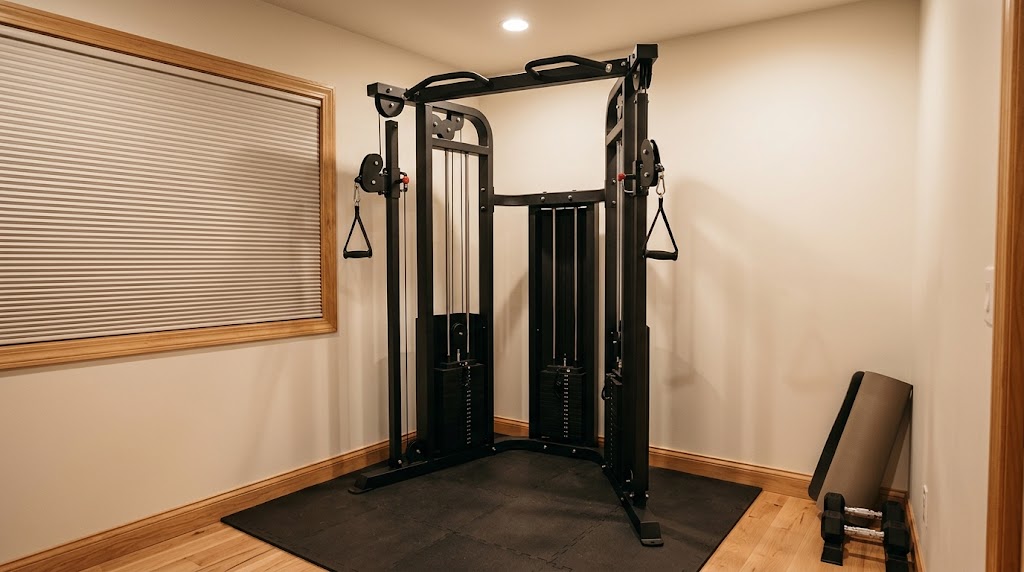
When a compact gym machine makes sense
Individual pieces of equipment (dumbbells, bands, a pull-up bar) work for most people in most spaces. But some people want a single machine that does everything in one footprint, either because they prefer guided movement patterns, they are recovering from injury and need controlled ranges of motion, or they simply want to load heavier than adjustable dumbbells allow.
The compact home gym market has exploded since 2020. Machines that once required a full garage now fold, slide, or compress into a footprint smaller than a dining table. The trade-off is always the same: the more compact the machine, the more compromises in maximum resistance, cable smoothness, and exercise variety.
Categories of compact gym machines
Cable-based systems
These use a weight stack or resistance bands routed through a pulley system. Cable exercises are the most versatile because the cable can move through any plane of motion: push, pull, rotate, lift, lower. The Lifepro Multifunctional Home Gym offers dual cable stations, a lat bar, a low row, and multiple handle attachments in a footprint under 15 sq ft. Weight stack goes up to 150 lbs, which covers most isolation and accessory work.
For heavier loads, you step up to larger units with 200 to 300 lb stacks. These are no longer "compact" but are still smaller than the equivalent collection of individual machines.
Resistance band machines
Machines like the Tonal or Tempo use electromagnetic resistance or heavy bands instead of metal weight stacks. The advantage is near-silent operation and a very small footprint (Tonal mounts to a wall). The disadvantage is cost ($3,000 or more plus a monthly subscription) and a maximum resistance that caps around 200 lbs total, which is limiting for strong lifters on compound movements.
If you are considering a smart gym machine, check whether it requires a monthly subscription to function. Some lock basic features behind a paywall. That turns a one-time purchase into an ongoing cost that adds up significantly over 3 to 5 years of ownership.
Smith machine / power rack combos
Compact smith machines combine a guided barbell track with cable attachments, a pull-up bar, and sometimes a bench. They provide the heaviest loading in the smallest footprint. A barbell on a smith track lets you squat, bench press, overhead press, and row at weights that exceed any cable machine or band system.
The trade-off is size: even "compact" smith machines need a 5 by 7 foot floor area and 7 to 8 feet of ceiling clearance. They also weigh 200 to 400 lbs, so they are not moving once assembled. This is a garage or dedicated room solution, not a living room one.
What to check before buying
Maximum resistance
Calculate your working weight for the exercises you plan to do most. If you bench 185 lbs and the machine's max chest press resistance is 150 lbs, the machine cannot grow with you. Bodyweight exercises do not have this ceiling, which is one reason simple equipment (a pull-up bar, suspension trainer, and dumbbells) often outlasts machines.
Footprint: assembled vs in use
The assembled footprint is the floor space the machine takes at rest. The in-use footprint includes your body, the cable extensions, and the bench if one attaches. A machine with a 3 by 4 foot assembled footprint often needs 5 by 8 feet in use. Measure both before committing.
Cable smoothness
Cheap pulleys create jerky, uneven resistance. This matters because jerky cables make exercises feel inconsistent, which makes progressive overload hard to track. Nylon-coated cables through sealed bearings are the minimum quality standard for a machine that feels good to use.
Weight progression increments
Pin-loaded stacks jump in 5 to 10 lb increments. For smaller muscles (lateral raises, tricep extensions), 10 lb jumps are too big. Look for machines with 2.5 lb add-on plates or a plate-loaded option where you can add standard barbell plates in any increment you own.
| Type | Footprint | Max load | Price range | Best for |
|---|---|---|---|---|
| Cable system | 10 to 15 sq ft | 100 to 200 lbs | $200 to $800 | Isolation, accessories |
| Smart / band machine | 5 to 10 sq ft | 150 to 200 lbs | $1,500 to $4,000 | Guided training, tech integration |
| Smith machine combo | 25 to 40 sq ft | 300 lbs or more | $500 to $2,000 | Heavy compound lifts |
Do you actually need a machine?
For most apartment and small-space gym users, the answer is no. A set of adjustable dumbbells, a flat bench, a pull-up bar, and gym flooring covers every major movement pattern at a fraction of the cost and footprint. Machines make sense when you need guided motion (injury rehab, joint limitations), want heavier loading than dumbbells provide, or simply prefer the feel of cable exercises.
If you do choose a machine, budget for the long term. A $300 cable machine that feels smooth and loads to your working weight is a better investment than a $2,000 smart machine that requires a $40/month subscription and caps at 200 lbs.
Bottom line
Compact gym machines solve real problems for specific people: those who need guided movement, heavy loading in one footprint, or the motivation that a machine provides over free weights. For everyone else, the combination of dumbbells, bands, and bodyweight equipment remains cheaper, smaller, and more versatile. Know your actual training needs before committing to a machine that may not fit your space or your programme six months from now.