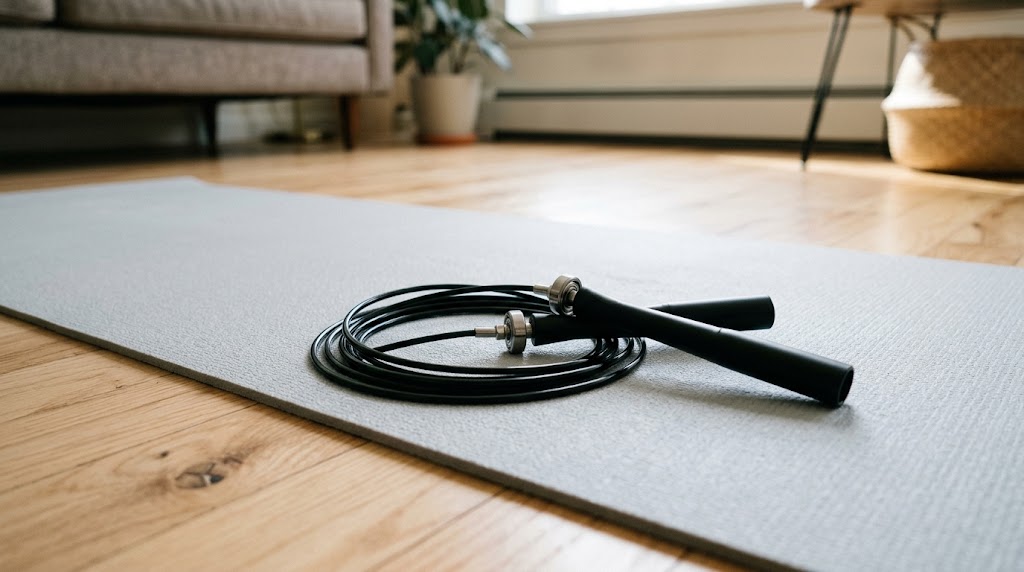
Why jump rope is the best apartment cardio
A jump rope packs into a drawer, costs under $20, and burns 10 to 16 calories per minute depending on intensity and body weight. That puts it ahead of running, cycling, and rowing in calories per minute per dollar per square foot. It is the most space-efficient cardio tool that exists.
The apartment problem is not the rope. It is the ceiling, the floor, and the neighbours. A standard rope needs 10 to 12 inches of clearance above your head. Foot impact travels through floors. The rope itself makes a slapping sound on every revolution. All three problems are solvable with the right rope, the right surface, and the right technique.
Ceiling clearance: the first measurement
Stand where you plan to jump. Raise your arms overhead with fists closed, as if you are holding a rope at the top of the arc. Add 10 inches above your fists. That is the minimum ceiling height you need. For most people, this works out to about 10 to 12 inches more than your height.
Standard apartment ceilings are 8 feet (96 inches). If you are 5 foot 10 (70 inches), your hands reach roughly 84 inches overhead, plus 10 inches for the rope arc puts you at 94 inches. That is tight but workable. If you are over 6 feet, standard ceilings may not work. In that case, move to a garage, hallway, or outdoor space, or switch to a cordless weighted rope.
Three types of jump ropes
Speed ropes
Thin cable (usually coated steel wire), lightweight plastic handles, ball-bearing swivel. These rotate fast and are ideal for double-unders and high-speed intervals. The thin cable is quiet but unforgiving: mistimed jumps sting. Weight ranges from 3 to 6 oz total.
Weighted ropes
Heavier cables (1/2 inch diameter or thicker) or handles with removable weights. Total rope weight ranges from 1 to 5 lbs. The added resistance turns jump rope from pure cardio into a combined cardio and upper-body workout. Shoulders, forearms, and grip all work harder. The trade-off is slower rotation and more rope slap noise.
Cordless (ropeless) weighted ropes
Short weighted handles with small balls on 6-inch cords instead of a full rope. You get the arm and shoulder workout of a weighted rope with zero floor impact from the rope, zero ceiling clearance issues, and zero noise. The trade-off is no trip feedback (you cannot time actual jumps to a rope) and no skipping coordination training. These are excellent for apartments with low ceilings or thin floors.
The floor problem
Each jump lands 100 to 200 lbs of force on a small area. On bare hardwood, tile, or concrete, that transmits straight through to the unit below. Three solutions:
Jump rope mat: A dedicated 4 to 6 mm thick PVC or rubber mat absorbs impact and protects the floor surface. It also gives the rope a consistent surface to pass over, which reduces snagging and extends rope life.
Interlocking foam tiles: BalanceFrom foam tiles or similar 3/4 inch EVA tiles laid in a 4x4 foot area. More cushioning than a thin mat but takes up permanent floor space unless you disassemble after each session.
Thick rubber mat: A 4x6 foot horse stall mat (3/4 inch solid rubber) is the gold standard for noise reduction. Heavy, expensive, and effective. Overkill for jump rope alone but worthwhile if you also do kettlebell swings or dumbbell work in the same area.
Getting the length right
Stand on the centre of the rope with one foot. Pull the handles up along your body. For beginners, the handles should reach your armpits. For intermediate jumpers, mid-chest. For experienced speed rope users, nipple line or slightly below.
Too long and the rope drags, catches on the floor, and slows your rhythm. Too short and you hunch forward to compensate, which loads your lower back. Most quality ropes are adjustable. Cheap ropes sometimes are not. This is not a feature to skip.
Apartment-friendly jump rope programme
Start with 30-second intervals. Jump for 30 seconds, rest for 30 seconds. Repeat 10 times. Total workout time: 10 minutes. Total active jumping: 5 minutes. That is enough to elevate your heart rate significantly and burn 80 to 120 calories.
Progress by extending the work interval (45 seconds, then 60) or shortening the rest (20 seconds, then 15). Once you can jump continuously for 3 minutes, you have a solid cardio base. From there, add double-unders, criss-crosses, or high-knee jumps for variety.
Jump during times when impact noise matters least. Mid-morning to early evening is typically the safest window in apartment buildings. Avoid 6 to 8 AM and after 9 PM unless you have ground floor clearance or very thick floors.
Bottom line
A jump rope is the cheapest, smallest, and most effective cardio tool for apartment living. Measure your ceiling, get an adjustable rope, and put a mat down. If your ceiling is too low or your floors are too thin, a cordless weighted rope solves both problems while still giving you the shoulder and cardio workout. Pair it with a bodyweight routine and you have a complete fitness programme in a drawer.