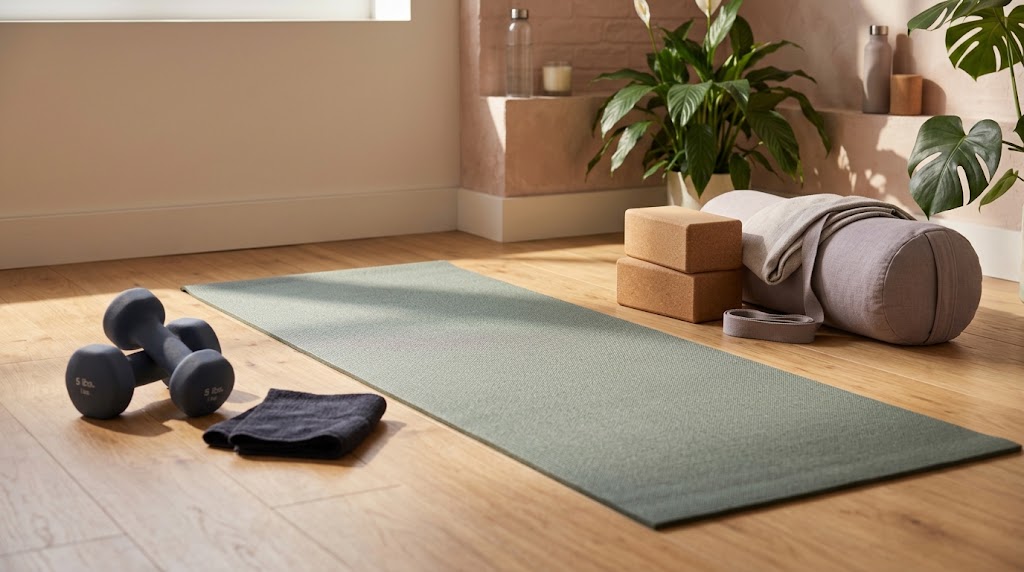
If you lift weights, use resistance bands, or do bodyweight training at home, you already know the feeling: tight shoulders after push-ups, stiff hips after squats, sore lower back after deadlifts. The standard fix is rest days and maybe some foam rolling. But there is a reason professional athletes and serious strength coaches keep coming back to yoga as the recovery tool that actually delivers measurable results.
Yoga improves range of motion, reduces delayed-onset muscle soreness (DOMS), promotes blood flow to damaged muscle tissue, and teaches you to breathe through discomfort rather than brace against it. That last point matters more than most people realise, because chronic bracing patterns from heavy lifting can limit mobility over time. A 20-minute recovery flow after training breaks that cycle.
Why Yoga Works for Strength Recovery
The mechanism is not mysterious. Strength training shortens muscle fibres under load. Over time, without deliberate lengthening, your resting muscle length decreases. This is why lifters who never stretch gradually lose the ability to fully extend their arms overhead or squat to full depth. Yoga holds stretched positions for 30 to 90 seconds, which is long enough to trigger the stretch reflex and allow the muscle to actually lengthen rather than just temporarily give way.
The breathing component is equally important. Slow, diaphragmatic breathing during yoga activates your parasympathetic nervous system, which shifts your body from the "fight or flight" state of training into "rest and digest" mode. This hormonal shift accelerates recovery. Studies published in the International Journal of Yoga have shown that yoga practitioners recover faster between training sessions and report less perceived soreness compared to passive rest alone.
The Five Best Recovery Poses (and What Gear Helps)
1. Pigeon Pose (Hip Flexors and Glutes)
After squats, lunges, or any lower-body work, your hip flexors and glutes tighten significantly. Pigeon pose is the single best hip opener in yoga. The problem for most strength athletes is that tight hips make it impossible to sink into the pose comfortably without support.
This is where a yoga bolster earns its keep. The Gaiam Yoga Bolster Pillow placed under your front hip provides enough lift to take the strain off your knee and let your hip flexor actually release. Without support, most people just hang there in pain, which causes the muscle to guard rather than stretch. The bolster makes the difference between a productive stretch and a wasted one.
2. Supported Fish Pose (Chest and Shoulders)
Push-ups, bench press, and any pressing movement tightens the chest and rounds the shoulders forward. Supported fish pose reverses this by opening the chest over a prop placed along your spine.
Two Trideer Yoga Blocks stacked (one under your upper back, one under your head) create the exact elevation needed. The cork surface stays grippy even with post-workout sweat, and the firm density provides real support without compressing under your body weight. Hold for 3 to 5 minutes while breathing slowly, and your shoulders will sit noticeably further back when you stand up.
3. Reclined Spinal Twist (Lower Back)
The lower back takes load in almost every compound lift. A reclined spinal twist decompresses the lumbar spine and stretches the paraspinal muscles that get locked short from bracing. You do not need any props for the basic version, but a Aozora Yoga Bolster Pillow placed between your knees keeps the twist gentle and controlled, which is important when your back is already fatigued from training.
4. Wheel Rollout (Thoracic Spine)
The thoracic spine (mid-back) stiffens from both strength training and prolonged sitting. A yoga wheel provides a targeted extension that foam rollers cannot match because of the narrower contact point and the curved rolling motion.
The NGT 13-Inch Yoga Wheel is particularly useful post-training because the thick padding cushions sensitive vertebrae while the narrow width reaches between the shoulder blades where tension concentrates. Start sitting on the floor, place the wheel behind your mid-back, and slowly roll up and down for 2 to 3 minutes. Most people hear their mid-back release within the first minute.
5. Legs Up the Wall (Active Recovery)
This is the simplest recovery pose and arguably the most effective for lower-body training days. You literally lie on your back with your legs resting vertically against a wall. Gravity drains metabolic waste from your legs and reduces swelling. Hold for 5 to 10 minutes post-training.
A Retrospec Sedona Meditation Cushion under your hips elevates the pelvis slightly, which increases the drainage effect and makes the pose comfortable enough to hold for the full 10 minutes. The buckwheat hull filling conforms to your sacrum without creating pressure points.
Building a Recovery Routine
You do not need to do all five poses every session. Pick 2 to 3 based on what you trained that day:
- After upper body: Supported fish pose + reclined spinal twist. Focus on opening the chest and decompressing the spine. 15 minutes total.
- After lower body: Pigeon pose (both sides) + legs up the wall. Target the hips and let gravity assist recovery. 15 to 20 minutes total.
- After full body: Wheel rollout + pigeon pose + legs up the wall. Cover the major tension points. 20 minutes total.
The timing matters. Doing yoga immediately after training (within 30 minutes) is more effective than waiting until the next day. Your muscles are warm and more responsive to stretching, and the parasympathetic activation helps you transition out of training mode before the evening.
How This Connects to Your Existing Gear
If you already have a foam roller from our recovery guide, the yoga wheel and bolster complement rather than replace it. Foam rollers are better for broad, superficial muscle groups (quads, IT band, calves). Yoga wheels and blocks target deeper, more specific areas (thoracic spine, hip flexors, chest opening). Using both creates a recovery system that covers everything.
The same goes for resistance bands. A yoga strap and a resistance band look similar but serve opposite purposes: the band creates resistance to strengthen through a range of motion, while the strap provides passive assistance to reach deeper into a stretch. Keeping both in your home gym kit means you can train and recover with the same space footprint.
The Minimal Recovery Kit
If you train at home 3 to 5 days per week and want to add yoga recovery without spending much or taking up space:
- Two yoga blocks ($13 for the Trideer 2 Pack)
- One yoga wheel ($25 for the NGT wheel)
- A good yoga mat ($20 to $28; see our apartment mat guide)
Total: roughly $58 to $66 for a complete recovery setup that stores in a corner and lasts years. That is less than a single sports massage session, and the daily access means you will actually use it consistently rather than booking appointments you keep rescheduling.
As an Amazon Associate, I earn from qualifying purchases at no extra cost to you, which helps keep this site running.