Bands are not a compromise
There is a perception that resistance bands are a lightweight substitute for "real" equipment. That is wrong. Bands provide progressive resistance (the tension increases as the band stretches), which loads the muscle differently from dumbbells. Research published in the Journal of Sports Science & Medicine has shown that elastic resistance can produce comparable strength and muscle gains to free weights when the effort level is matched.
More practically, a full set of bands fits in a drawer. Try saying that about a dumbbell rack.
What you need
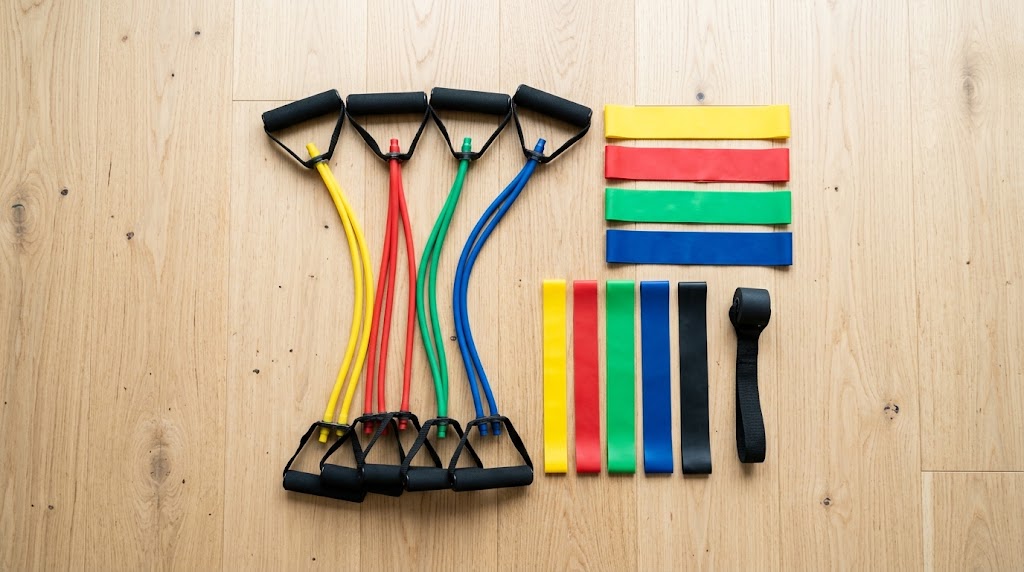
Two types of bands cover everything:
- Tube bands with handles: The WHATAFIT resistance bands set comes with five tubes of different resistances, two handles, two ankle straps, and a door anchor. Stack multiple tubes on the handles to increase resistance up to 150 pounds.
- Loop bands: The Fit Simplify resistance loop bands are flat latex loops in five resistance levels. They work for lower-body activation (glute bridges, lateral walks, clamshells) and lighter upper-body work.
A multi-point door anchor strap turns any apartment door into a cable station with high, mid, and low attachment points. No holes in the wall, no hardware to install.
Full body workout with bands
Upper body
Banded chest press: Anchor the tube band at chest height behind you. Step forward until there is tension, then press both handles forward until your arms are straight. Squeeze at the front. Three sets of 12 to 15 reps.
Banded row: Anchor at chest height in front of you. Pull both handles toward your ribs, squeezing your shoulder blades together. Three sets of 12 to 15 reps.
Overhead press: Stand on the tube band, grip the handles at shoulder height, and press overhead. Three sets of 10 to 12 reps.
Bicep curl: Stand on the band, curl the handles to your shoulders. Three sets of 12 to 15 reps.
Tricep pushdown: Anchor high. Face the door, grip the handles, and push down until your arms are straight. Three sets of 12 to 15 reps.
Lower body
Banded squat: Stand on the tube band, handles at shoulder height. Squat to parallel and stand. The increasing tension at the top makes the lockout harder than a bodyweight squat. Three sets of 12 to 15 reps.
Lateral band walk: Place a loop band around both legs just above the knees. Step sideways in a half-squat position. Ten steps each direction, three sets.
Banded Romanian deadlift: Stand on the tube band, hinge at the hips with handles at your thighs. The band tension builds as you return to standing. Three sets of 12 reps.
Glute bridge with loop band: Loop band above knees. Lie on your back, feet flat, drive hips up while pressing knees outward against the band. Three sets of 15 reps.
Core
Pallof press: Anchor the tube band at chest height to one side. Stand perpendicular to the anchor. Hold the handle at your chest, then press it straight out in front of you. The band tries to rotate your torso; resist it. Hold for 3 seconds, return. Ten reps per side, two sets.
Stretching after band work
Bands are excellent for assisted stretching too. A Trideer stretching strap with its ten loops lets you ease into hamstring, hip flexor, and shoulder stretches with controlled, progressive tension. Five minutes at the end of a session makes a real difference to flexibility over time.
When to add resistance
Unlike dumbbells, band resistance is not a fixed number. It changes through the range of motion. Progress by using a thicker band, stacking two tubes on one handle, or stepping further from the anchor point. If you can complete 15 reps without the last two feeling genuinely hard, it is time to increase resistance.
Bands wear out over time, especially in direct sunlight or heat. Check for nicks and thin spots regularly. A snapped band mid-set is not dangerous if you are using a door anchor properly, but it will end your workout early.