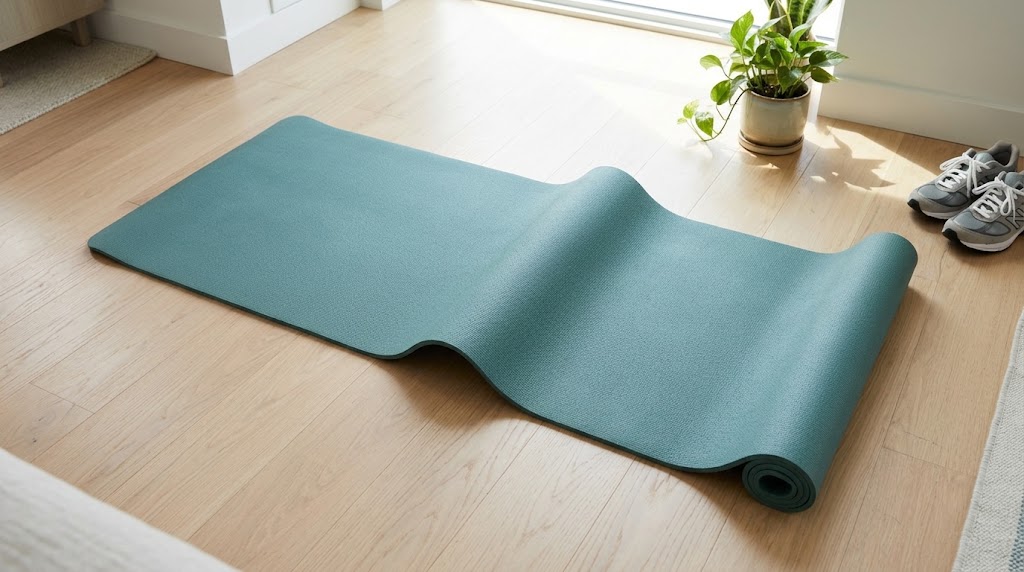
Yoga is one of the few workouts that genuinely thrives in a tiny apartment. You need roughly the length of your body and a metre of width. No racks, no cables, no ceiling clearance issues. But the mat you choose matters more in a small space than it does in a padded studio, because a thin mat on bare laminate or concrete feels punishing on your knees, and a slippery one on polished wood is a genuine safety hazard.
After spending dozens of hours reading user reviews, comparing spec sheets, and cross-referencing real buyer feedback from thousands of verified purchasers, here is what actually works for apartment yoga on hard flooring.
Why Thickness Matters on Hard Floors
Standard yoga mats run about 3mm thick. That is fine on a sprung studio floor or carpet, but on tile, hardwood, or concrete it offers almost nothing between your kneecap and the ground. For home practice on hard surfaces, you want at least 6mm. Some people go thicker (12mm to 15mm), but past a certain point you lose the firm ground contact that balance poses depend on. The sweet spot for most apartment practitioners is 6mm to 10mm.
Thickness also affects noise. A thicker mat absorbs impact from transitions and jumps, which means less thudding transmitted through the floor to downstairs neighbours. If you live above someone, this is not a luxury feature. It is a requirement.
Non-Slip Surface: the Real Differentiator
Every yoga mat claims to be non-slip. The reality is that grip degrades on cheaper mats within weeks, especially if you sweat. For hard floor apartments, you need a mat that grips the floor underneath (so it does not slide across polished surfaces) and grips your hands and feet on top. Textured TPE and natural rubber surfaces handle this best. Smooth PVC mats look nice in photos but become skating rinks when damp.
Our Top Picks for Apartment Yoga
Best Overall: Gruper Non-Slip Eco-Friendly Yoga Mat
The Gruper Non-Slip Eco-Friendly Yoga Mat hits the apartment trifecta: 6mm thickness for joint cushioning, dual-layer TPE for grip on both sides, and a carrying strap included so you can hang it on the back of a door when not in use. It weighs under a kilogram, rolls tight, and thousands of verified buyers consistently mention how well it stays put on hardwood and tile. The textured surface actually improves grip when your palms get sweaty, which is the opposite of what most budget mats do.
At around $28, it sits in that zone where you are paying for genuine quality improvements over a basic mat without crossing into premium territory. If you are starting apartment yoga and want one mat that handles everything from vinyasa flow to yin stretching on hard floors, this is where the research consistently points.
Best Budget Pick: CAP Barbell High Density Exercise Mat
The CAP Barbell 1/2-Inch High Density Exercise Yoga Mat goes thicker at roughly 12mm, which makes it exceptional for anyone practicing on concrete or very hard tile. The high-density foam absorbs impact without bottoming out during kneeling poses. At under $20, it is one of the most affordable options that actually delivers on its thickness claims. The trade-off is that it is slightly heavier and less compact when rolled, but if your mat lives in one spot at home, that is irrelevant.
One thing worth noting: the extra thickness does make standing balance poses slightly wobblier. If you are doing a lot of tree pose or warrior three, you might prefer the firmer 6mm options. But for general practice, floor work, and anyone with sensitive joints, the cushioning is hard to beat at this price.
Best for Daily Practice: Amazon Basics Extra Thick Exercise Yoga Mat
The Amazon Basics Extra Thick Exercise Yoga Mat is 12mm of NBR foam with a textured surface and a carrying strap. It has accumulated tens of thousands of verified reviews, and the consistency of positive feedback across years of production is what makes it stand out. You know exactly what you are getting. The foam density holds up well over months of daily use without developing permanent compression marks, which is a common failure point in budget mats.
At around $22, it sits between the CAP and the Gruper in both price and firmness. If you want something proven by sheer volume of real-world testing and you plan to use it five or more days per week, the durability track record here is strong.
Worth Considering: BalanceFrom High Density Exercise Mat
The BalanceFrom 1-Inch Extra Thick High Density Exercise Mat goes all the way to 25mm (one full inch). That is extremely thick for a yoga mat, which makes it better suited for people who combine yoga with other floor exercises like pilates, ab work, or stretching routines. On bare concrete, the extra cushioning is genuinely appreciated. Buyers with knee issues frequently mention that this is the first mat that lets them do kneeling poses without discomfort.
The trade-off is that you will feel less ground connection in balance poses, and the mat takes up more space when rolled. But at around $20 for a mat that doubles as a general exercise surface, it is excellent value for a home gym that needs to cover multiple activities.
What to Look For: Quick Checklist
- Thickness: 6mm minimum for hard floors. 10mm to 12mm if you have knee sensitivity.
- Material: TPE or natural rubber for best grip. NBR foam for maximum cushioning. Avoid smooth PVC if you sweat.
- Size: Standard is 183cm by 61cm. Check this fits your designated floor space before ordering.
- Storage: Look for a carrying strap or bag. In a small apartment, being able to hang the mat vertically saves real floor space.
- Weight: Under 1kg is ideal if you move the mat daily. Over 1.5kg is fine if it lives in one spot.
One Mat or Two?
Some apartment yogis keep a thin travel mat for balance-focused sessions and a thick mat for restorative or floor-heavy practices. If you have the storage space for two, it is a practical approach. A 6mm Gruper for vinyasa and a 12mm Amazon Basics for yin yoga and stretching covers essentially every scenario you will encounter at home.
If you are buying one mat and one only, lean toward the 6mm to 8mm range. It is the best compromise between cushioning and stability, and you can always fold a towel under your knees for the occasional pose that needs extra padding.
Bottom Line
A good yoga mat for apartment practice on hard floors does not need to cost $80. The mats listed here range from $19 to $28 and all have thousands of verified positive reviews from people using them in exactly the conditions you are dealing with: hard flooring, limited space, and noise-conscious neighbours. The Gruper is the best all-round choice, the CAP is the best budget option, and the Amazon Basics is the most battle-tested for daily use.
As an Amazon Associate, I earn from qualifying purchases at no extra cost to you, which helps keep this site running.