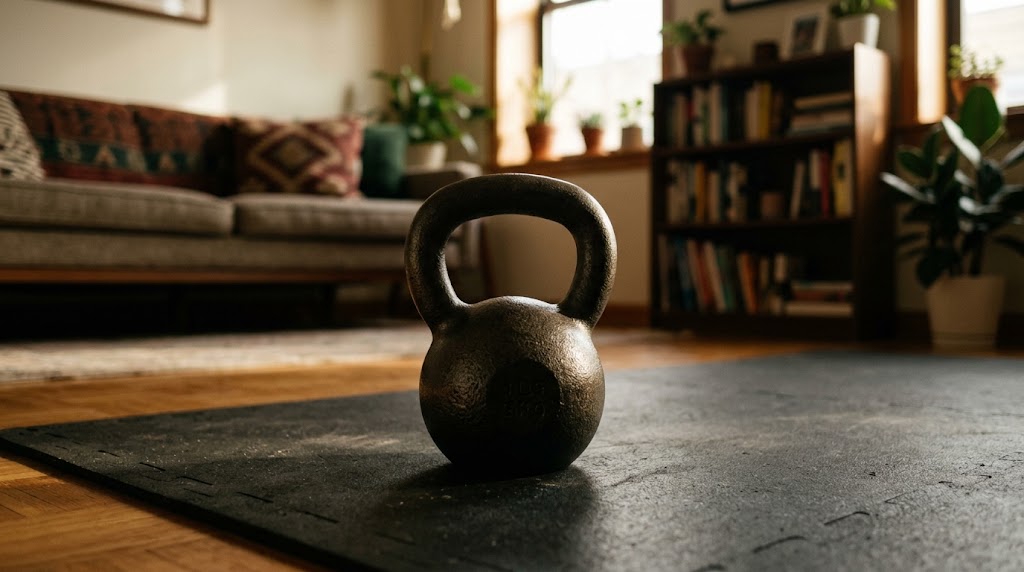
Why kettlebells work in small spaces
A kettlebell takes up less floor space than a water bottle. The exercises are mostly vertical (swings, presses, squats, cleans) rather than horizontal, so you do not need the room a bench press or rowing machine demands. And because kettlebell training combines strength and cardiovascular conditioning in the same movement, you can get a complete workout in 20 to 25 minutes.
The Bowflex SelectTech 840 adjustable kettlebell covers six weight settings (8, 12, 15, 20, 25, and 40 pounds) in one unit. That range handles everything from light Turkish get-ups to heavy two-hand swings without cluttering your apartment with half a dozen individual bells.
Essential kettlebell exercises
The two-hand swing
This is the foundational kettlebell movement. Stand with feet slightly wider than hip-width, the bell on the floor between your feet. Hinge at your hips, grip the handle with both hands, and hike the bell backward between your legs. Drive your hips forward explosively to swing the bell to chest height. Let gravity bring it back down and repeat.
Start at 15 to 20 pounds. Three sets of 15 reps with 60 seconds of rest between sets. You will feel this in your hamstrings, glutes, lower back, and shoulders.
Goblet squat
Hold the kettlebell at your chest with both hands on the sides of the handle (the "goblet" position). Squat until your thighs are parallel to the floor or below. Keep your chest up and your weight in your heels. Three sets of 10 to 12 reps.
Single-arm press
Clean the kettlebell to your shoulder (one hand). Press it overhead until your arm is straight, then lower with control. The offset weight forces your core to stabilise, which you do not get with a barbell. Three sets of 8 reps per side.
Turkish get-up
This is the most technical kettlebell exercise, and it is worth learning. Start lying on your back with the kettlebell pressed to the ceiling in one hand. Move through a series of positions (rolling to the elbow, posting on the hand, sweeping the leg through to kneeling, standing) while keeping the bell overhead. Reverse the process to return to the floor.
Start with no weight or the lightest setting (8 pounds) until you know the movement. Two reps per side is plenty when you are learning.
Single-arm row
Hinge forward at the hips about 45 degrees. Pull the kettlebell from a dead hang to your hip, elbow travelling close to your ribs. The offset handle creates a different grip challenge from a dumbbell row. Three sets of 10 per side.
Floor protection for swings
Kettlebell swings involve momentum. If you miss a rep or set the bell down firmly, your floor will know about it. A set of BalanceFrom foam floor tiles provides basic protection for lighter work. For heavier swings (above 25 pounds), a rolled rubber mat is a better choice. It will not compress the way foam does, and it absorbs impact noise more effectively.
Recovery after kettlebell sessions
Swings and cleans load the posterior chain (hamstrings, glutes, back) intensely. A short foam rolling session focused on those areas makes a real difference. The 321 STRONG foam roller is compact enough to fit under a couch, and 5 minutes on your hamstrings and upper back after training helps reduce next-day stiffness.
For deeper knots, especially in the forearms and shoulders after pressing work, a Theragun Mini is worth considering. It fits in a nightstand drawer and targets specific trouble spots more precisely than a foam roller can.
Programming basics
A simple and effective kettlebell routine for apartments:
- Day A: Two-hand swings (3 x 15), goblet squats (3 x 12), single-arm press (3 x 8 per side)
- Day B: Turkish get-ups (2 per side), single-arm rows (3 x 10 per side), single-arm swings (3 x 12 per side)
Alternate days, training three times per week. Rest at least one day between sessions. Increase the weight setting on the Bowflex 840 when you can hit the top of the rep range on all sets with solid form.