The case for bodyweight training
Bodyweight exercises require no equipment, make no noise, and can be done in less space than a yoga mat occupies. That makes them the most apartment-friendly training method that exists. The limitation people assume (you cannot get strong with bodyweight alone) is a misunderstanding of how progression works.
With weights, you progress by adding more weight. With bodyweight, you progress by changing the leverage, the angle, or the stability of the exercise. A push-up becomes harder when you elevate your feet. A squat becomes harder when you do it on one leg. The muscle does not know the difference between a 50-pound dumbbell press and a ring dip at the same effort level. Tension is tension.
Essential bodyweight equipment
You can start with nothing, but a few tools dramatically expand what is possible:
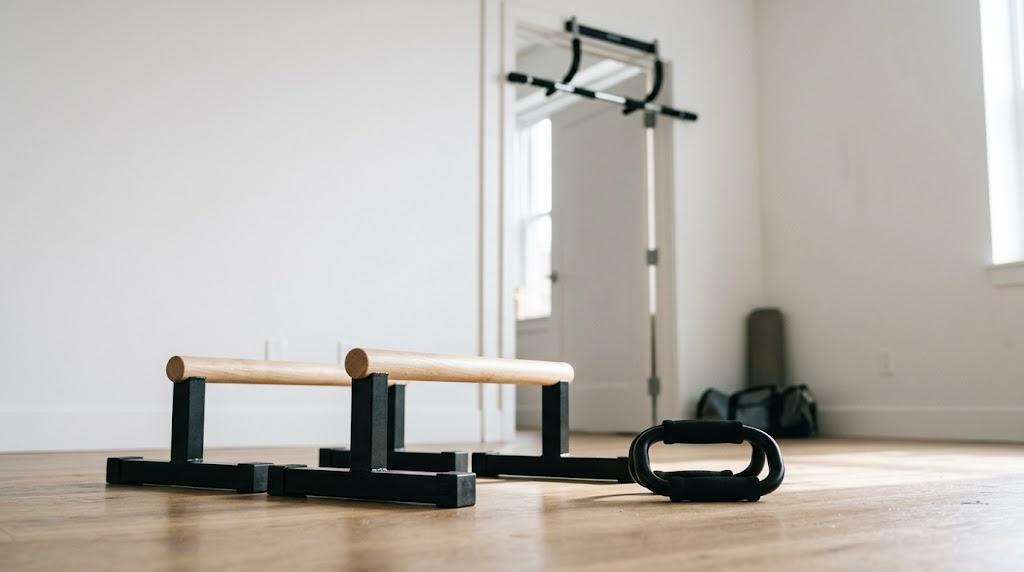
- Iron Gym upper body workout bar or Ally Peaks doorway pull-up bar: Opens up the entire pulling category (pull-ups, chin-ups, hanging leg raises). Without one, your back training is severely limited.
- Perfect Pushup Elite: Rotating handles that reduce wrist strain and increase range of motion on push-ups. The rotation also engages more of the stabiliser muscles in the shoulder.
- PULLUP & DIP parallettes: Enable L-sits, dips, planche progressions, and handstand push-up training. These unlock the more advanced bodyweight movements that build serious upper-body strength.
- Ab roller wheel: The ab rollout is one of the most effective core exercises ever studied. It loads the entire anterior chain under stretch, which is something sit-ups and crunches cannot do.
Progression roadmaps
Push-ups to advanced pressing
- Wall push-ups (if regular push-ups are too hard)
- Knee push-ups
- Full push-ups
- Push-ups on Perfect Pushup Elite handles (deeper range of motion)
- Diamond push-ups (hands together, tricep focus)
- Decline push-ups (feet elevated on a bench or chair)
- Archer push-ups (one arm does most of the work)
- One-arm push-up (the end goal for pushing strength)
Pull-ups progression
- Dead hang (just hold the bar; build grip strength)
- Negative pull-ups (jump to the top, lower yourself slowly over 5 seconds)
- Band-assisted pull-ups (loop a resistance band over the bar and step into it)
- Full pull-ups
- Chin-ups (palms facing you; more bicep involvement)
- Wide-grip pull-ups
- L-sit pull-ups (legs held horizontal while pulling)
- Weighted pull-ups (backpack with books)
Squat progression
- Assisted squat (holding a doorframe for balance)
- Bodyweight squat
- Pause squat (3-second hold at the bottom)
- Bulgarian split squat (rear foot elevated on a chair)
- Shrimp squat (reaching one leg behind you)
- Pistol squat (single-leg squat, free leg extended forward)
Core progression
- Plank holds (30 to 60 seconds)
- Ab wheel rollout from knees
- Ab wheel rollout from feet (advanced)
- L-sit on parallettes (hold for time)
- Hanging leg raises on the pull-up bar
Adding instability for a new challenge
Once you have built a foundation with these progressions, adding an unstable surface changes the difficulty dramatically. A BOSU balance trainer under your feet during squats or under your hands during push-ups forces your stabiliser muscles to work much harder. Synergee core sliders on a hard floor enable exercises like mountain climbers, pike slides, and hamstring curls that are nearly impossible to replicate with other equipment.
How to programme bodyweight training
Pick one exercise from each progression at the level where you can complete 3 sets of 5 to 8 reps (or 20 to 30 second holds for isometric exercises). Train three to four days per week, alternating between upper-body and lower-body focus. When you can complete 3 sets of 12 reps (or 45-second holds) at a given level, move to the next progression step.
Bodyweight training is not faster or slower than weight training for building strength. It is different. The skill component is higher, which means the early stages feel clumsy. Stick with it through that phase and you will develop a kind of body control that dumbbells alone do not build.