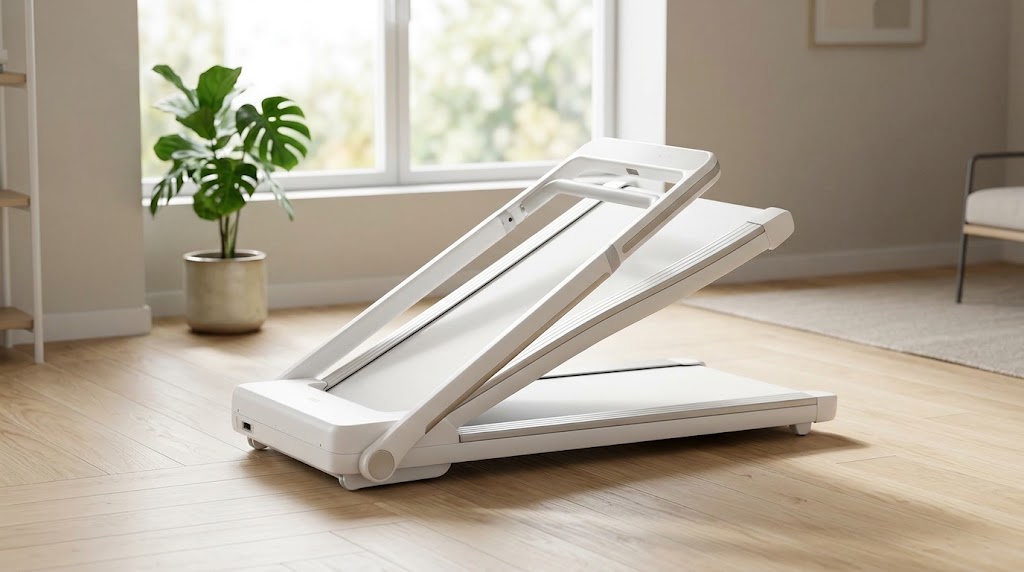
Why folding treadmills have changed
Five years ago, a folding treadmill was a compromise. Thin belt, weak motor, wobbly frame. You bought one because you did not have space for a real treadmill, and you accepted that it would feel like running on a wobble board. That has changed. The 2025 and 2026 generation of compact treadmills pack 2.5 to 3.0 HP motors, shock-absorbing decks, and Bluetooth app integration into frames that fold to under 6 inches thick.
The category has also split. Walking pads sit under a desk and top out at 4 mph. Folding treadmills fold vertically or horizontally and run up to 7.5 to 12 mph. Knowing which category you actually need saves you money and floor space.
Walking pad vs folding treadmill
Walking pads
Flat, low-profile decks designed for walking at 1 to 4 mph. No handles, no incline. They slide under a desk or sofa when not in use. Ideal for desk workers who want to hit 8,000 to 10,000 steps during a work day without changing clothes or blocking a room. Not suitable for running or intense cardio.
If you already have a walking pad desk setup, the fit is straightforward. The question is whether you also want the option to run.
Folding treadmills
Full-sized decks (typically 16 to 20 inches wide, 45 to 55 inches long) with motors rated 2.0 to 3.5 HP. Handles fold down or the deck folds up. Speed ranges from 0.5 to 12 mph. Incline from 0 to 15 percent on powered models. These are proper running machines that also fold for storage.
The folded footprint matters more than the unfolded one. A treadmill you cannot store easily becomes a permanent furniture piece, and in a small apartment that is a problem. Look for models that fold to under 10 inches thick and have transport wheels.
What to look for
Motor power
Walking: 1.0 to 2.0 HP is sufficient. Jogging: 2.0 to 2.5 HP. Running: 2.5 HP minimum, 3.0 HP preferred. Continuous horsepower (CHP) is the number that matters, not peak HP. Some brands advertise peak HP, which is the motor's burst capacity and not sustainable.
Belt size
Width should be at least 16 inches for walking, 18 inches for jogging, 20 inches for running. Length should be at least 48 inches for walking, 52 inches for jogging, 55 inches for running. Taller users (over 6 feet) need 58 inches or more to avoid clipping the front shroud.
Noise level
This matters enormously in apartments. Motor noise is one factor; belt slap and foot impact are the other two. Brushless motors are quieter than brushed ones. Multi-layer decks with cushioning reduce foot strike noise. If you live above a neighbour, add a treadmill mat underneath to absorb vibration. The combination of a quiet treadmill plus a dense rubber mat can drop perceived noise by 30 to 40 percent for the floor below.
Folding mechanism
Hydraulic-assisted folding is worth the premium. Soft-drop systems prevent the deck from slamming open. Lock pins or latches keep it folded during storage. Test the fold before you commit: if it takes two hands and real effort, you will stop folding it, and it will live permanently unfolded.
Three options across the price range
| Feature | Budget Walking Pad | Mid-Range Folder | Performance Folder |
|---|---|---|---|
| Speed range | 0.5 to 4 mph | 0.5 to 7.5 mph | 0.5 to 12 mph |
| Motor | 1.5 HP | 2.5 HP | 3.0 HP CHP |
| Belt width | 16 in | 17.5 in | 20 in |
| Incline | None | Manual 3-level | Auto 0 to 15% |
| Folded height | 5 in | 8 in | 12 in |
| Weight capacity | 220 lbs | 265 lbs | 300 lbs |
| Best for | Desk walking | Walk/jog mix | Serious running |
For desk walking, a basic walking pad in the $150 to $250 range does the job. If you want to jog, step up to a 2.5 HP model with a wider belt. For actual running, you need 3.0 HP, auto incline, and a belt long enough for a full stride. The price jump from walking pad to running treadmill is significant (roughly $200 to $800 or more), but the versatility is worth it if running is part of your programme.
Fitting a treadmill into a small space
The ideal spot is near a wall outlet, away from furniture edges you might hit if you step off unexpectedly, and with at least 3 feet of clearance behind the belt. That rear clearance is a safety requirement, not a suggestion. If the belt stops and you do not, you need space to step off.
Vertical folders store against a wall. Horizontal folders slide under a bed or sofa. Walking pads lean against a wall or slide into a closet. Measure your storage spot before buying, and check the folded dimensions against that space. A treadmill that folds to 6 by 27 by 54 inches still needs a spot that size.
If noise and floor space are both constraints, also consider a rowing machine, which provides comparable cardio benefits in a similar footprint and is quieter on impact.
Bottom line
Define the problem first. If you want steps during work hours, a walking pad under your desk is sufficient and affordable. If you want to run, invest in a proper folding treadmill with a 3.0 HP motor and a belt wide enough for your stride. Either way, measure your storage space first, check the folded dimensions, and budget for a floor mat underneath.