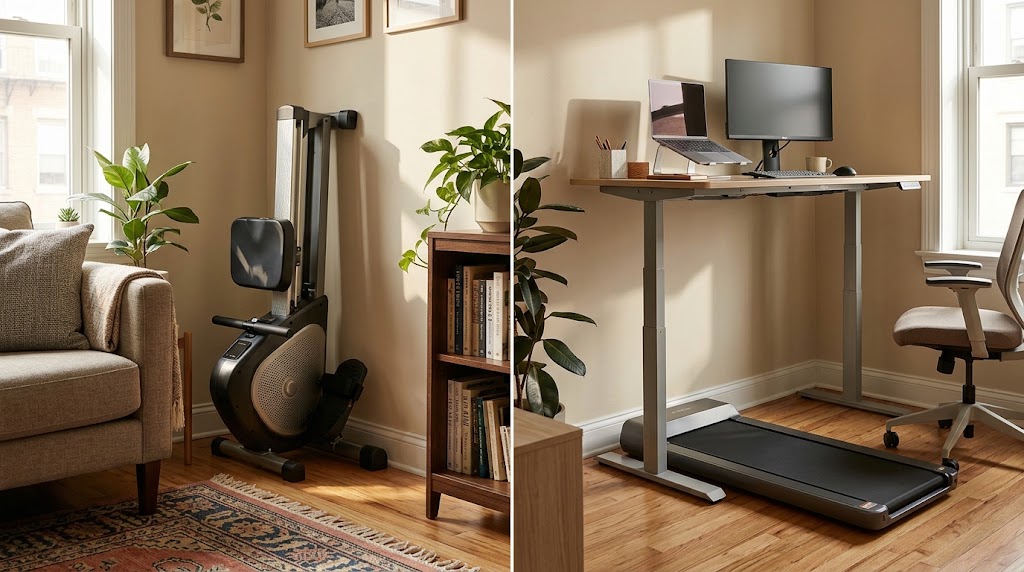
Two different tools for two different problems
A rowing machine and a walking pad both provide cardiovascular exercise in a compact space. But they solve fundamentally different problems, and choosing between them depends on what you actually need from your training.
A walking pad adds gentle, sustained movement to your day. It pairs with desk work and requires almost no physical recovery. A rowing machine delivers a full-body, moderate-to-high intensity workout that demands your full attention for 20 to 40 minutes.
Neither is objectively better. They serve different purposes, and for many people, the right answer is eventually both.
Walking pad: the case for steady movement
The Sperax walking pad folds flat, weighs about 55 pounds, and slides under a bed or behind a sofa. It runs under 50 decibels, which is quiet enough for phone calls and shared spaces. Top speed is typically 3.8 mph, but most people walk at 1.5 to 2.5 mph while working.
The Sperax 3-in-1 with incline adds a manual incline setting. Walking at even a moderate incline increases calorie burn by 30 to 50 percent compared to flat walking at the same speed, and it engages the glutes and hamstrings more effectively.
Best for: remote workers who sit most of the day, people recovering from injury, anyone who wants to add 6,000 to 10,000 steps daily without a separate workout block.
Calories burned: roughly 100 to 200 per hour depending on speed and incline.
Muscles worked: primarily legs (quads, calves, glutes). Minimal upper-body involvement.
Rowing machine: the case for full-body intensity
Rowing uses roughly 86 percent of your muscles in a single stroke. Legs drive the initial push, the back and core transfer power, and the arms finish the pull. It is one of the most complete cardiovascular exercises that exists, and it does it with zero impact on your joints.
The Sunny Health magnetic rowing machine uses magnetic resistance, which means it is nearly silent (no whooshing fan or splashing water). It folds upright for storage, taking up about 2 by 2 feet of floor space when not in use.
The MERACH R25 foldable rowing machine has a slightly more premium feel with 16 resistance levels and Bluetooth connectivity. It also folds, and the magnetic resistance keeps it apartment-friendly.
Best for: people who want dedicated cardio sessions, those who need upper-body conditioning alongside leg work, anyone looking for high calorie burn in a short timeframe.
Calories burned: roughly 400 to 600 per hour depending on intensity and resistance level.
Muscles worked: legs, back, core, shoulders, arms. True full-body.
Head-to-head comparison
| Factor | Walking Pad | Rowing Machine |
|---|---|---|
| Space when stored | Folds flat, slides under bed | Folds upright, 2 x 2 ft footprint |
| Space when in use | About 4.5 x 1.5 ft | About 7 x 2 ft |
| Noise level | Very low (under 50 dB) | Low with magnetic resistance |
| Multitasking | Yes (work, calls, reading) | No (requires full attention) |
| Intensity | Low | Moderate to high |
| Impact | Low | Zero |
| Muscle engagement | Legs only | Full body (86% of muscles) |
| Calorie burn per hour | 100 to 200 | 400 to 600 |
| Learning curve | None | Moderate (proper form matters) |
| Price range | $200 to $400 | $250 to $600 |
Floor protection for both
Both machines transmit vibration through the floor, especially on hard surfaces. A set of BalanceFrom foam floor tiles beneath either machine reduces vibration, protects the floor surface, and keeps the machine from sliding. For a rowing machine, which has a longer footprint, you may need two or three tiles placed end to end.
Which should you buy first?
If you work from home and your main problem is too much sitting, start with a walking pad. The health benefit of replacing 2 to 3 hours of sitting with gentle walking is significant, and you get it without carving out a separate workout block.
If you already have a reasonably active daily routine (or you do not work from home) and you want a time-efficient dedicated workout, the rowing machine delivers more fitness per minute than almost any other home equipment.
If you can afford both and have the space, they complement each other well. Walk during work hours for baseline movement, row 3 to 4 times per week for cardiovascular and muscular conditioning. That combination covers both the "move more throughout the day" and "train hard in dedicated sessions" bases.