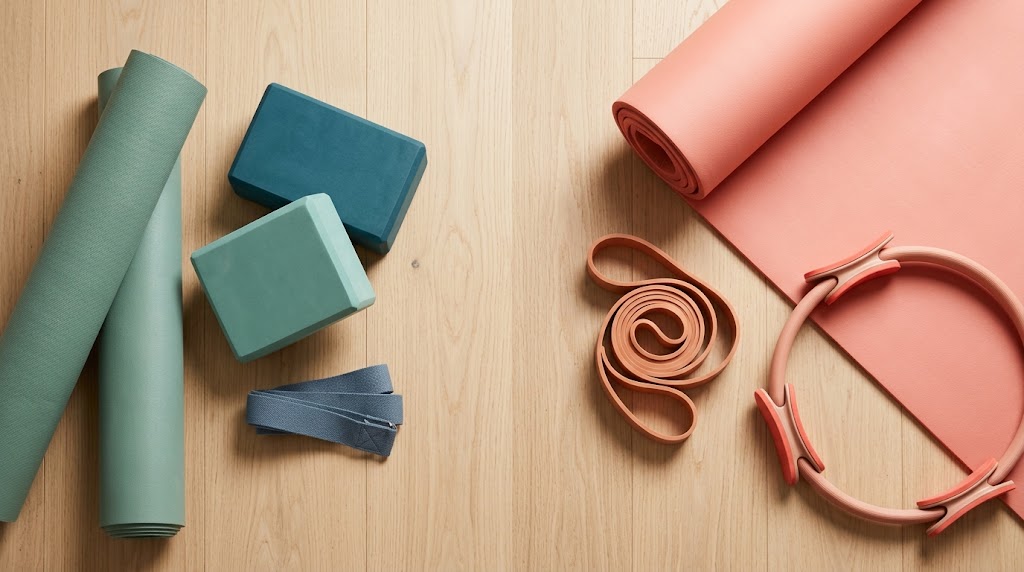
Both yoga and pilates rank among the best workouts you can do in a small apartment. Both use minimal equipment, generate almost no noise, and require roughly the same floor footprint. But they train your body in different ways, use different props, and the experience of doing each one at home is quite distinct. If you are choosing between them (or considering doing both), here is a practical comparison based on gear, space, cost, and what each one actually delivers.
The Core Difference
Yoga emphasises flexibility, balance, and mindful breathing through held poses. Pilates emphasises core strength, controlled movement, and muscular endurance through repetitive exercises. There is overlap (both improve posture, both use body weight, both work on a mat), but the intent is different. Yoga asks you to find stillness in a challenging position. Pilates asks you to move with precision through a challenging sequence.
For home fitness, this difference matters because it affects what you buy and how much space you need.
Gear Comparison
| Item | Yoga | Pilates | Shared? |
|---|---|---|---|
| Exercise mat | Essential (6mm to 10mm) | Essential (10mm to 15mm, thicker preferred) | Partly (pilates mats are typically thicker) |
| Blocks | Highly recommended | Not used | No |
| Strap | Recommended | Not standard | No |
| Resistance bands | Not standard | Commonly used | Partial |
| Pilates ring | Not used | Common prop | No |
| Bolster/cushion | Useful for restorative | Not standard | No |
| Small exercise ball | Not standard | Common prop | No |
| Yoga wheel | Optional (back relief) | Not used | No |
The key takeaway: yoga props help you access poses you cannot yet reach. Pilates props add resistance to movements you can already do. Both are inexpensive, but they are largely different purchases.
What Yoga Gear Costs
A complete yoga setup for home practice:
- Mat: $19 to $28. The Gruper Non-Slip Yoga Mat ($28) is the best all-round option for hard floors.
- Two blocks: $13 to $27. The Trideer Yoga Blocks 2 Pack ($13) offers the best value.
- Strap: Often bundled with blocks. The Rocalt Cork Blocks with Strap ($27) includes both blocks and a 10-loop strap.
- Optional yoga wheel: $25. The NGT 13-Inch Yoga Wheel for back relief.
Total: $32 to $80 depending on how complete a setup you want.
What Pilates Gear Costs
- Mat: $20 to $35 (thicker than yoga mats, 12mm to 15mm). The BalanceFrom 1-inch mat works well for both disciplines.
- Resistance bands: $10 to $20 for a set. If you already have bands from strength training (see our resistance band guide), you are covered.
- Pilates ring: $12 to $25 for inner-thigh and arm exercises.
- Small exercise ball: $8 to $15 for core work.
Total: $50 to $95 for a full mat pilates setup.
Costs are comparable. Yoga is slightly cheaper at the basic level because blocks and straps cost less than rings and balls.
Space Requirements
Both need roughly the same floor space: a rectangle about 183cm by 90cm (6 feet by 3 feet). That is your mat plus a little room on each side for extended arms and legs.
The difference is in vertical space. Yoga includes standing poses (warrior, tree, mountain with arms raised) that need ceiling clearance. If your apartment has low ceilings (under 2.3 metres / 7.5 feet), some standing poses with overhead reach might feel cramped. Pilates is predominantly floor-based, so ceiling height is irrelevant.
For storage, yoga gear is slightly more compact. Two blocks and a strap fit in a shoe box. Pilates rings and exercise balls take up more volume and do not stack neatly. Neither amount of equipment is burdensome in a small space, but yoga wins marginally on tidiness.
Fitness Benefits Side by Side
| Benefit | Yoga | Pilates |
|---|---|---|
| Flexibility | Excellent | Good |
| Core strength | Moderate | Excellent |
| Balance | Excellent | Good |
| Muscle endurance | Moderate | Excellent |
| Stress reduction | Excellent | Good |
| Posture correction | Excellent | Excellent |
| Calorie burn (30 min) | 120 to 180 (flow style) | 150 to 250 (intermediate) |
| Recovery support | Excellent | Good |
Neither is objectively "better." They excel in different areas. Yoga is the stronger choice for flexibility, recovery, and stress management. Pilates is the stronger choice for core strength and muscular endurance. Both are excellent for posture.
Can You Do Both?
Absolutely, and this is actually the recommendation most fitness professionals make. Yoga and pilates complement each other extremely well. A practical weekly schedule for home fitness might look like:
- Monday, Wednesday, Friday: Pilates (core and strength focus, 30 minutes)
- Tuesday, Thursday: Yoga (flexibility and recovery focus, 20 to 30 minutes)
- Weekend: Restorative yoga or rest
If you already do bodyweight strength training, yoga is the better complement because it fills the flexibility and recovery gap. If you do minimal strength work and want to build core strength, pilates is the priority.
The Shared Gear: One Mat, Two Disciplines
If you plan to do both, buy a mat that works for both. A 10mm mat is the compromise thickness: thick enough for pilates floor work, firm enough for yoga balance poses. The Amazon Basics Extra Thick Exercise Yoga Mat at 12mm handles both disciplines well and costs around $22.
Then add discipline-specific props as needed. Start with yoga blocks and a strap for your yoga sessions. Add a pilates ring and resistance bands when you are ready to progress your pilates practice. Buying incrementally means you spend money on gear you actually use rather than a full kit that sits in a corner.
Bottom Line
If you sit at a desk all day and need to undo the damage: start with yoga. If you want to build visible core strength and muscle tone with minimal equipment: start with pilates. If you have 30 minutes a day and want the broadest fitness benefit: alternate between both. The gear cost for either is under $80, the space requirement is identical, and neither makes enough noise to bother your neighbours.
As an Amazon Associate, I earn from qualifying purchases at no extra cost to you, which helps keep this site running.