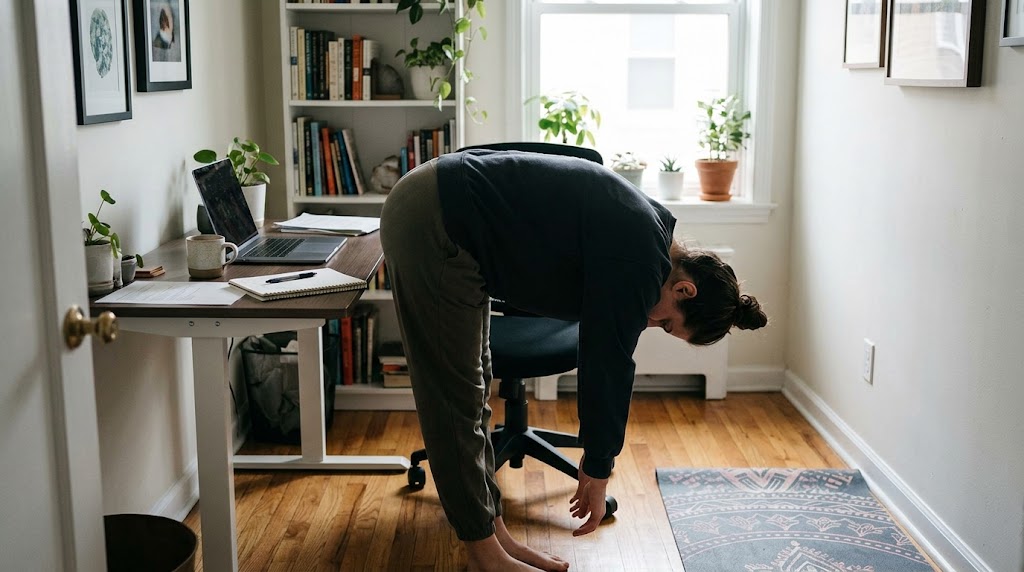
Eight hours of sitting does predictable things to your body: your hip flexors shorten, your chest tightens, your shoulders round forward, and your lower back aches. You know this because you feel it every evening. What you might not know is that 20 minutes of targeted yoga can reverse most of those effects, and you do not need flexibility, experience, or a studio membership to do it. You need a mat, possibly a block, and a patch of floor.
What Desk Sitting Actually Does to Your Body
When you sit, your hip flexors (the muscles connecting your thighs to your pelvis) are held in a shortened position for hours. Over time, they adaptively shorten, which tilts your pelvis forward and compresses your lower back even when you stand up. Your chest muscles (pectorals) also shorten because your arms are held in front of you at a keyboard. This pulls your shoulders forward and overstretches your upper back muscles, which is why the area between your shoulder blades burns by the afternoon.
Your thoracic spine (the middle section of your back) gradually stiffens in a flexed position, reducing your ability to rotate and extend. This creates a cascading effect: reduced thoracic mobility forces your lumbar spine and cervical spine to compensate, leading to lower back pain and neck tension. It is a mechanical chain reaction, and it accelerates the longer you sit without interruption.
The good news: these are all reversible with consistent, targeted stretching. You are not dealing with structural damage. You are dealing with muscles that have learned the wrong resting length. Yoga teaches them the correct one.
Routine 1: the After-Work Reset (20 Minutes)
Do this sequence in order. Each pose builds on the opening created by the previous one. Hold each pose for 5 to 8 slow breaths (roughly 60 to 90 seconds).
Cat-Cow (2 minutes)
Start on all fours. Inhale and drop your belly toward the floor while lifting your head and tailbone (cow). Exhale and round your spine toward the ceiling while tucking your chin and tailbone (cat). Repeat slowly for 2 minutes. This warms up the entire spine and reverses the locked flexion position from sitting.
Low Lunge with Reach (3 minutes, each side)
Step your right foot forward into a deep lunge with your left knee on the mat. Sink your hips toward the floor and reach your left arm overhead, leaning slightly right. This simultaneously opens the left hip flexor (which was shortened all day) and the left side of your torso. Use a Gaiam Yoga Block under your front hand if you cannot comfortably reach the floor. Switch sides and repeat.
Thread the Needle (2 minutes, each side)
From all fours, slide your right arm under your left arm and lower your right shoulder and temple to the floor. This rotates your thoracic spine and stretches the muscles between your shoulder blades that have been overstretched and painful all day. Paradoxically, stretching these muscles in a controlled way relieves the tension better than just massaging them.
Supported Fish Pose (4 minutes)
Place two Trideer Yoga Blocks on the mat: one at the medium height under your upper back (roughly where your bra strap or mid-shoulder blades sit) and one flat under the back of your head. Lie back over them and let your arms fall open to the sides. This is the single best desk-reversal pose. It opens your chest, extends your thoracic spine, and puts your shoulders back where they belong. Stay for a full 4 minutes with slow breathing.
Seated Forward Fold (3 minutes)
Sit with your legs extended. Loop a yoga strap (or a towel) around the balls of your feet and hold one end in each hand. Hinge forward from your hips, keeping your spine as straight as possible rather than rounding. Let the strap take the tension so you can relax into the stretch rather than straining. The Syntus Yoga Block and Strap Set is useful here because the strap length is designed for exactly this type of seated pose.
This stretches the entire posterior chain: hamstrings, lower back, and the fascia running along your spine. After a full day of sitting, the back of your body is locked short, and this pose addresses the full length of it.
Reclined Spinal Twist (3 minutes, each side)
Lie on your back. Bring your right knee to your chest, then guide it across your body to the left while keeping your right shoulder on the floor. Turn your head to the right. Hold and breathe. Switch sides. This decompresses the lumbar spine and stretches the outer hip (which tightens from sitting with crossed legs or in a fixed position).
Routine 2: the Midday Break (10 Minutes, Chair-Optional)
You do not always have 20 minutes or the motivation to get on the floor. This abbreviated routine works standing or using a chair, making it practical during a lunch break.
Standing Forward Fold (2 minutes)
Stand with feet hip-width apart. Fold forward from the hips and let your head hang heavy. Bend your knees slightly if your hamstrings are tight. Grab opposite elbows and gently sway. This inverts the position you have been holding all morning and lets gravity decompress your spine.
Chair Pigeon (2 minutes, each side)
Sit at the front edge of your chair. Cross your right ankle over your left knee (making a figure-four shape). Keep your right foot flexed to protect the knee. Lean forward gently from the hips. This opens the outer hip and glute, which compress against the chair all day.
Doorframe Chest Stretch (2 minutes)
Stand in a doorframe with your arms bent at 90 degrees, forearms resting on the frame. Step one foot forward and lean through the doorframe until you feel a stretch across your chest. This is the standing equivalent of supported fish pose and reverses the shoulder rounding from typing.
Seated Twist (2 minutes, each side)
Sit tall in your chair. Place your right hand on your left knee and your left hand behind you on the chair back. Twist to the left, leading with your chest, not your neck. Hold for 60 seconds, then switch sides. This restores some thoracic rotation that sitting eliminates.
How Often Should Desk Workers Do Yoga?
Daily is ideal. The effects of sitting accumulate every day, so the counterbalance needs to happen daily too. But even 3 to 4 sessions per week produce noticeable improvements in posture and pain levels within 2 to 3 weeks. Consistency matters more than duration. A 10-minute daily practice beats a 60-minute weekend session for addressing desk-related tightness.
The best time is immediately after your last work session, before you transition to evening activities. Your body is at its tightest and most compressed at this point, so the relief is most noticeable. It also creates a clear mental boundary between work mode and personal time, which is valuable if you work from home.
The Desk Worker Starter Kit
You need remarkably little to start:
- A yoga mat (6mm or thicker for hard floors). Our apartment mat guide covers the best options from $19 to $28.
- Two yoga blocks for supported fish pose and lunge support. The Trideer 2 Pack at $13 is the best value.
- A yoga strap for forward folds if you cannot reach your toes. The Syntus Block and Strap Set at $25 covers both a block and a strap.
If you already have an under-desk elliptical or a walking pad, adding a yoga routine addresses a different dimension of the sitting problem. Movement devices keep your legs active during work; yoga restores the flexibility and posture that sustained sitting erodes. The two approaches complement each other well.
As an Amazon Associate, I earn from qualifying purchases at no extra cost to you, which helps keep this site running.