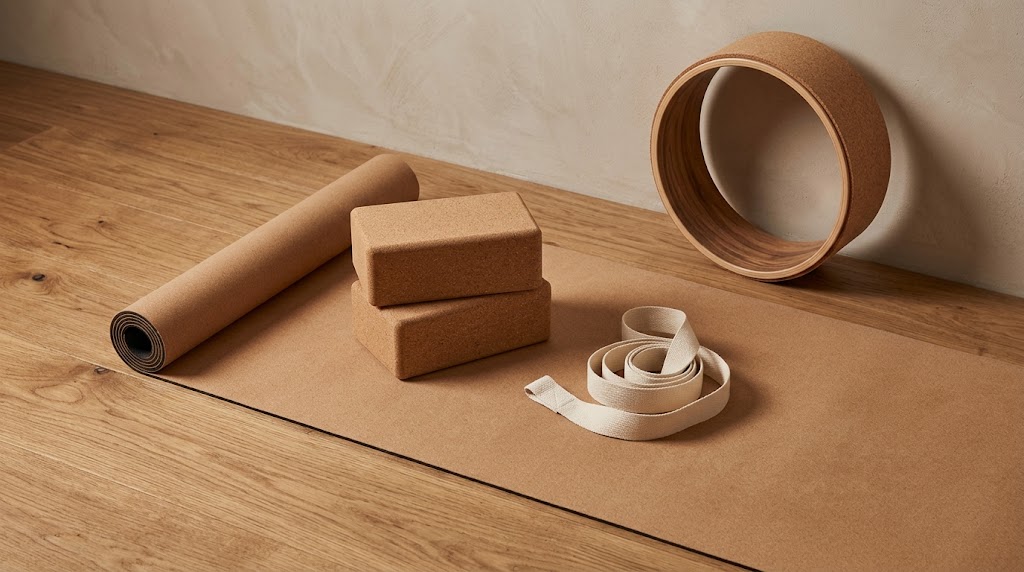
Walk into any yoga accessories aisle (real or digital) and you will find blocks, straps, wheels, bolsters, cushions, towels, eye pillows, and at least three things you cannot identify. It is overwhelming, and most of it is unnecessary for home practice. Here is what research and thousands of verified buyer reviews say about which props actually earn their space in a small apartment.
Yoga Blocks: the One Prop Everyone Should Own
Blocks are the single most useful yoga prop. They bring the floor closer to you in standing poses, support your back in reclined positions, and give your hands something stable to press into when your flexibility has not caught up with your ambition. Even experienced practitioners use them. They are not a beginner crutch; they are a tool that makes poses accessible and safer at every level.
The two main materials are EVA foam and cork. Foam blocks are lighter, cheaper, and softer. Cork blocks are heavier, firmer, and more stable under load. For apartment yoga, where you are usually on a hard floor, cork has an edge because it does not compress or wobble when you put real weight through it.
Best Foam Block: Gaiam Yoga Block
The Gaiam Yoga Block is the single best-selling yoga block on Amazon, with nearly 30,000 reviews and a 4.8-star rating. It is a standard 9 by 6 by 4-inch EVA foam block with bevelled edges for comfortable grip. At around $15 for a single block, it is the low-risk starting point. Most people buy two for symmetrical support in poses like bridge and supported fish.
What buyers consistently praise is the density. Cheaper foam blocks feel spongy and unstable. The Gaiam holds its shape under pressure while still being soft enough that pressing your back or hips into it is comfortable. It also holds up well over time without developing permanent dents.
Best Cork Block Set: Trideer Yoga Blocks 2 Pack
The Trideer Yoga Blocks 2 Pack leads the cork block market with around 7,000 monthly sales on Amazon. Each block is firm, heavy enough to feel planted, and naturally antimicrobial (cork resists bacteria and odour). The non-slip surface actually improves when your hands are slightly damp, which is useful in flow sequences where you build heat.
At roughly $13 for two blocks, the Trideer set is remarkably good value for cork. The slight extra weight compared to foam (each block is about 300 grams heavier) is actually a benefit on hard floors because they do not skid when you shift your weight.
Premium Pick: Rocalt Natural Cork Blocks with Strap
The Rocalt Natural Cork Yoga Blocks 2 Pack with Strap and Storage Bag bundles two oversized cork blocks (9 by 6 by 4 inches) with a 10-loop yoga strap and a storage bag. At around $27, it is the all-in-one starter kit. The 10-loop strap design is particularly clever because you do not need to fiddle with D-rings or buckles; you just grab the loop at whatever length you need.
Yoga Straps: Flexibility You Do Not Have Yet
A strap extends your reach. That sounds simple, but it transforms poses that would otherwise be impossible for anyone who cannot touch their toes or clasp their hands behind their back. Seated forward folds, reclining leg stretches, and bound poses all become accessible with a strap looped around your foot.
The Syntus Yoga Block and Strap Set combines a 9 by 6 by 4-inch natural cork block with a cotton strap for around $25. If you want one block and one strap rather than a full two-block kit, this is a tidy solution that covers both essentials without cluttering your space.
The key spec to look for in a strap is length. Most are 6 feet (183cm), which works for the majority of people up to about 6 feet tall. If you are taller, look for an 8-foot option. Cotton straps are more comfortable against skin than nylon. D-ring buckles are more secure than plastic clips.
Yoga Wheels: Worth It for Back Pain
A yoga wheel is a hollow circle (usually 30 to 33cm diameter) that you roll along your spine. It opens the chest, stretches the hip flexors, and provides a deep backbend that is difficult to achieve any other way without an instructor physically adjusting you. For anyone who sits at a desk all day, the thoracic spine release from a yoga wheel is genuinely transformative.
The NGT 13-Inch Yoga Wheel supports up to 500 pounds, features thick TPE padding, and costs around $25. Buyers frequently compare it favourably to the much more expensive Chirp Wheel, noting that the core function (rolling out your back) works identically. The padding is thick enough that you do not feel the hard inner ring, even with full body weight.
For a premium option, the Chirp Wheel+ Foam Roller 3-Pack includes three different sizes (6, 10, and 12-inch) for targeting upper back, middle back, and lower back separately. At around $90 it is a significant investment, but over 5,400 reviews with a 4.4-star rating and consistent praise for the spinal channel design (which protects your vertebrae while pressing into the muscles alongside them) suggest it delivers on the premium price.
Bolsters and Cushions: for Restorative Practice
If your yoga practice includes restorative poses (where you hold supported positions for 3 to 10 minutes), a bolster is worth its weight. Literally. A good bolster supports your spine in reclining poses, elevates your hips in seated meditation, and provides the passive support that lets your muscles actually release instead of holding tension.
The Gaiam Yoga Bolster Pillow is a firm, cotton-filled rectangular bolster with a carry handle and washable cover. At around $36, it is one of the most popular bolsters on Amazon, selling roughly 1,000 units per month. The firmness is key: a bolster that compresses too much does not actually support you in restorative poses. Gaiam gets the density right.
For a meditation-specific cushion, the Retrospec Sedona Meditation Cushion is filled with buckwheat hulls that conform to your body and elevate your hips above your knees for proper seated alignment. At $27, it doubles as a comfortable floor seat for reading or working, which is a practical bonus in a small apartment.
What You Can Skip
- Yoga towels: A regular bath towel over your mat does the same job.
- Eye pillows: A folded hand towel or sleep mask works fine for savasana.
- Yoga gloves and socks: These exist to solve a grip problem that a good mat already solves.
- Fancy mat bags: The carrying strap that comes with most mats is all you need for the journey from your cupboard to your living room floor.
The Minimalist Yoga Kit for a Small Apartment
If you want the essential props and nothing more, here is what covers 95% of home yoga practice:
- Two yoga blocks (foam or cork, your preference). Around $13 to $27 for a pair.
- One yoga strap (cotton, 6 to 8 feet). Often bundled with blocks for free.
- A good mat (see our apartment yoga mat guide). Around $20 to $28.
Total cost: roughly $33 to $55 for a complete home yoga setup. That is less than a single month of studio classes in most cities.
Add a yoga wheel if you have back tension from desk work, and a bolster if you do restorative or yin yoga. Everything else is optional.
As an Amazon Associate, I earn from qualifying purchases at no extra cost to you, which helps keep this site running.