Why home gyms have a consistency problem
A commercial gym has built-in accountability. You pay a monthly fee, you drive there, you walk past other people training. All of those are small psychological nudges toward actually doing the workout. At home, none of those nudges exist. The couch is ten feet away. The fridge is closer. Nobody is watching.
Research from the University of Iowa found that people who exercise at home are 50% more likely to drop their routine within six months compared to gym goers. But the same research found that the people who stuck with home training had specific environmental and behavioural strategies that overcame the dropout tendency. The strategies below are drawn from that kind of research, not from motivational posters.
1. Make the default action easy
Behavioural scientists call this reducing friction. Every barrier between you and the workout increases the chance you skip it. At a gym, you have to get dressed, drive there, find a parking spot, and wait for equipment. At home, the only barriers are the ones you create.
Practical steps:
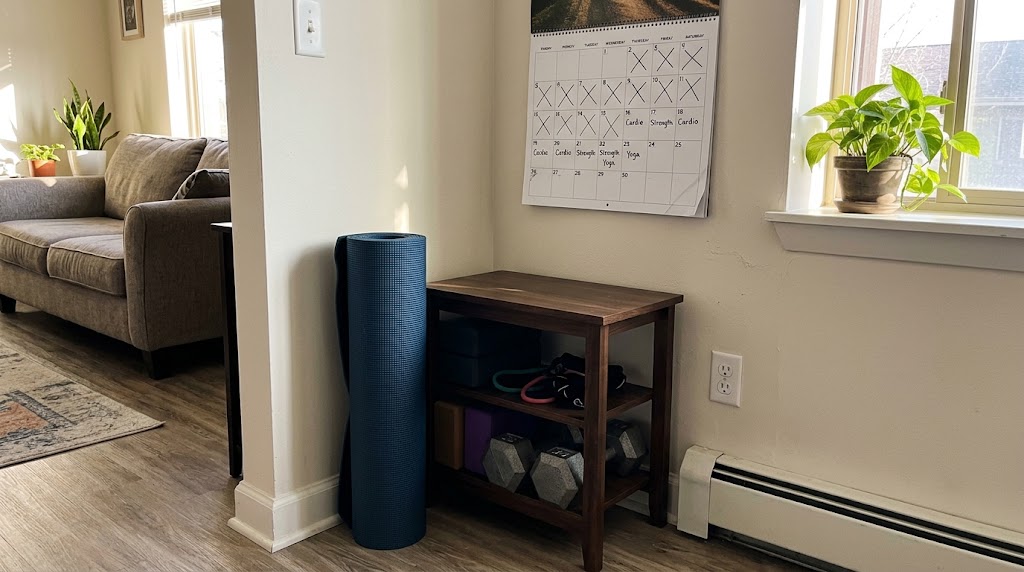
- Leave your equipment out. A pair of Bowflex SelectTech dumbbells sitting in the corner of your living room is a constant visual cue to train. Dumbbells stored in a closet are out of sight and out of mind.
- Set your training clothes out the night before. Changing clothes is a surprisingly effective trigger for switching into training mode.
- Keep your workout area clear. If you have to move boxes, fold laundry, or rearrange furniture before you can train, those become excuses on low motivation days.
2. Anchor your workout to an existing habit
Habit stacking is one of the most reliable behaviour change techniques. You attach a new habit (workout) to an existing one (something you already do every day without thinking).
Examples that work:
- After I make my morning coffee, I do a 5-minute warm up. The coffee brewing is the trigger. The warm up leads into the full workout.
- After my last work meeting ends, I change into training clothes. The meeting end is the trigger. Changing clothes is the first domino.
- After I put the kids to bed, I train for 30 minutes. The bedtime routine is the trigger.
The key is consistency of the anchor. If your trigger happens at different times every day, the chain breaks. Choose something that happens at roughly the same time, every day, regardless of what else is going on.
3. Set a minimum viable workout
On your worst day, when you are tired, distracted, and the couch is winning, what is the absolute minimum you would do? That is your floor. Not your goal. Your floor.
For most people, the minimum viable workout is 10 minutes. Three exercises, two sets each, no warm up heroics. The point is not that 10 minutes builds significant muscle. The point is that 10 minutes maintains the habit. And most of the time, once you start, you end up doing 25 to 30 minutes anyway because the hardest part was starting.
A RENPHO smart jump rope is useful here. Three minutes of jumping is enough to warm you up and shift you from "I do not feel like training" to "I am already moving, I might as well continue." The built-in counter gives you a small win right at the start.
4. Track something simple
Complex tracking systems die within two weeks. Spreadsheets with 20 columns, apps with mandatory workout logging, and programmes that require you to record every set and rep are maintenance burdens that feel like work.
What works is tracking one thing: did you train today, yes or no. A calendar on the wall with X marks for training days creates a visual streak that becomes psychologically painful to break. Jerry Seinfeld famously used this method for writing. It works for training because the motivation shifts from "I should work out" to "I do not want to break the chain."
A Fitbit Charge 6 automates this effortlessly. It detects exercise automatically, tracks active zone minutes, and shows your weekly activity streak on your wrist. You do not have to log anything manually. The streak updates itself.
5. Eliminate decision fatigue
Every decision you have to make before training is a potential exit point. "What exercises should I do? How many sets? Should I train upper or lower body? What music should I play?" Each question is a micro-opportunity to decide "not today."
The fix is a written programme. Not a flexible one. A rigid one. Monday is upper body. Wednesday is lower body. Friday is full body. The exercises, sets, and reps are predetermined. You walk to your equipment and execute what is written. No thinking required.
Our 4-week beginner programme is designed exactly this way. Every session is scripted. You just follow it.
6. Make it social (even alone)
You do not need a training partner to add social accountability. What you need is someone who knows you planned to train and will notice if you did not.
- A friend who also trains at home: Text each other when you finish your session. That is it. No comparison, no competition. Just "done" messages that create mutual accountability.
- Online communities: Reddit's r/homegym and r/fitness have daily check-in threads. Posting "completed day 15 of 28" creates a lightweight public commitment.
- Shared fitness tracker data: The Fitbit app lets you connect with friends and compare weekly active minutes. This works better than you would expect because nobody wants to be the person with zero minutes on a Wednesday.
7. Accept imperfect sessions
The all-or-nothing mindset kills more home gym routines than any other factor. "I only have 15 minutes so there is no point." "I cannot do my full programme so I will skip today." "I am not feeling 100% so I will wait until I feel better."
A 15-minute session with reduced weight and fewer sets is infinitely better than a skipped session. It maintains the habit, keeps your muscles active, and reinforces the identity that you are someone who trains. Waiting for perfect conditions means training roughly never.
Equipment that helps consistency
Certain equipment choices actively support consistency by reducing setup time, lowering barriers, and making workouts more engaging.
- Adjustable dumbbells like the Bowflex 552 take up minimal space and adjust instantly. No plate loading, no digging through a rack. Grab and go.
- Resistance bands weigh nothing, store in a drawer, and travel anywhere. A set of resistance bands means you can train in a hotel room, at a relative's house, or in a living room with zero setup.
- A visible timer or display. Knowing exactly how long you have been training (and how little time is left) reduces the "this is taking forever" feeling that leads to quitting mid-session.
The bottom line
Consistency is not about willpower. It is about systems. Reduce friction, anchor to existing habits, set a laughably low minimum, track one thing, eliminate decisions, add lightweight accountability, and stop waiting for perfect conditions. People who train consistently at home for years are not more motivated than people who quit after three weeks. They are better at designing their environment and their routines to make training the path of least resistance.