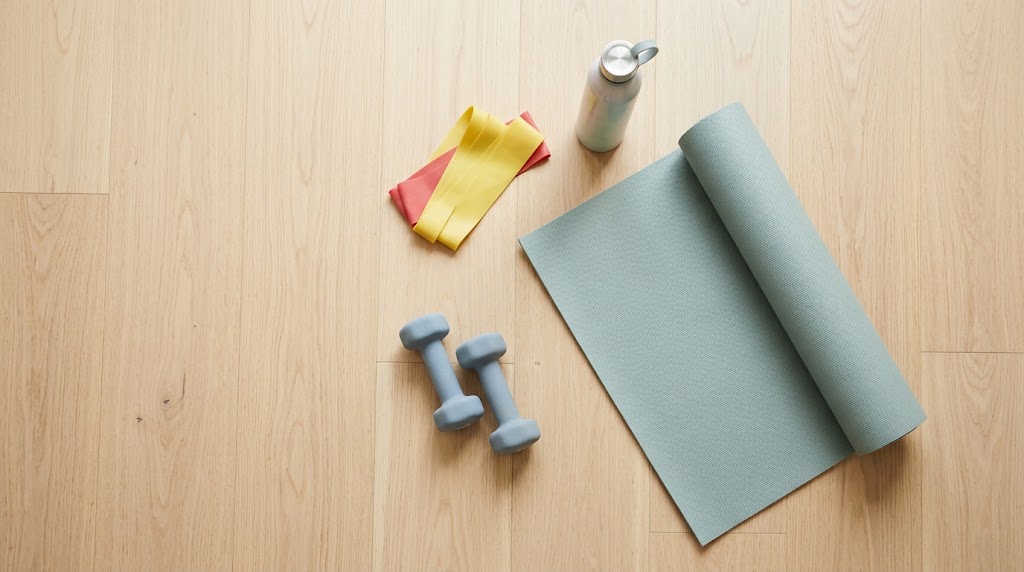
What you need
This programme uses three types of equipment. You do not need all of them on day one. Bodyweight exercises cover the first week, and you add resistance progressively.
- A set of adjustable dumbbells (10 to 50 lbs covers most beginners). The Bowflex SelectTech 552 adjustable dumbbells replace 15 pairs with a single set that takes up less space than a shoe rack.
- Resistance bands with handles. A set of resistance bands gives you five tension levels for around $30.
- A yoga mat for floor work. Any mat with decent cushioning works.
If you want to track your heart rate zones and recovery, a Fitbit Charge 6 helps you gauge intensity objectively rather than guessing whether you are working hard enough.
How the programme works
You train three days per week with at least one rest day between sessions. Each week adds one layer of difficulty: more reps in week two, added resistance in week three, and reduced rest periods in week four. The exercises stay the same so you can focus on getting better at each movement rather than learning new ones every session.
Each workout takes 30 to 40 minutes including warm up and cool down.
Week 1: Build the foundation
This week is about learning the movements and establishing the habit of showing up three times. Use bodyweight only or very light dumbbells. If an exercise feels too easy, that is fine. The goal is form, not fatigue.
Day A: Upper body
| Exercise | Sets | Reps | Rest |
|---|---|---|---|
| Push ups (knees or full) | 3 | 8 to 10 | 60 sec |
| Dumbbell rows (each arm) | 3 | 8 to 10 | 60 sec |
| Overhead press (light dumbbells) | 3 | 8 to 10 | 60 sec |
| Band pull-aparts | 3 | 12 to 15 | 45 sec |
| Plank hold | 3 | 20 to 30 sec | 45 sec |
Day B: Lower body
| Exercise | Sets | Reps | Rest |
|---|---|---|---|
| Bodyweight squats | 3 | 10 to 12 | 60 sec |
| Romanian deadlift (light dumbbells) | 3 | 8 to 10 | 60 sec |
| Reverse lunges (alternating) | 3 | 8 each leg | 60 sec |
| Glute bridges | 3 | 12 to 15 | 45 sec |
| Calf raises | 3 | 15 to 20 | 45 sec |
Day C: Full body
| Exercise | Sets | Reps | Rest |
|---|---|---|---|
| Goblet squats (light dumbbell) | 3 | 10 | 60 sec |
| Push ups | 3 | 8 to 10 | 60 sec |
| Band face pulls | 3 | 12 to 15 | 45 sec |
| Dumbbell curl to press | 3 | 8 | 60 sec |
| Dead bug | 3 | 8 each side | 45 sec |
Week 2: Add reps
Same exercises, same weight. Add 2 reps to every set. If the table said 8 to 10 reps in week 1, aim for 10 to 12 in week 2. The purpose is to build muscular endurance and confidence in each movement pattern before adding load.
If you cannot hit the higher rep range on every set, that is normal. Hit it on your first set and hold as close as you can on the remaining sets.
Week 3: Add resistance
Keep the rep range from week 2 but increase the dumbbell weight by 2.5 to 5 lbs per exercise. For band exercises, move up one tension level. For push ups, switch from knees to full push ups if you have not already, or elevate your feet on a step to increase difficulty.
This is where adjustable dumbbells pay for themselves. With fixed dumbbells you would need to buy another pair. With the Bowflex 552s, you turn a dial.
Week 4: Reduce rest, increase density
Same exercises, same weight as week 3. Cut every rest period by 15 seconds. Where you rested 60 seconds, rest 45. Where you rested 45, rest 30. This increases training density, which means more work in less time. Your heart rate will be higher and the sessions will feel harder even though you are lifting the same weight.
By the end of week 4, you will have completed 12 training sessions with progressive overload built in at every stage. That is enough to build a real base of strength and, more importantly, a training habit.
After the programme
Once you finish the four weeks, you have three options:
- Repeat with heavier weights. Run the same programme with the next dumbbell increment. This works for another two to three cycles before you need new exercises.
- Add equipment and complexity. A kettlebell opens up swings, Turkish get-ups, and goblet squats at heavier loads. A pull-up bar adds vertical pulling that bands and dumbbells cannot replicate.
- Move to a split routine. Once you can handle four training days per week, an upper/lower split lets you add volume for each muscle group without sessions dragging past 45 minutes.
Common mistakes beginners make
- Starting too heavy. If your form breaks down on rep 3, the weight is too heavy. Drop it. You will progress faster with controlled movement than with sloppy lifting.
- Skipping warm ups. Five minutes of dynamic stretching prevents the kind of tweaks that cost you an entire training week. A RENPHO smart jump rope makes a great warm up tool. Three minutes of jumping raises your heart rate and warms every major muscle group.
- Changing exercises every week. The urge to try new movements is strong, especially when social media shows you 50 variations of a bicep curl. Resist it. You get stronger by repeating movements, not by collecting them.
- Ignoring recovery. Progress happens during rest, not during the workout. Sleep 7 to 9 hours, eat enough protein (0.7 to 1 gram per pound of bodyweight), and use a foam roller on your rest days to reduce soreness and maintain mobility.
The bottom line
You do not need a complicated programme to start building strength at home. Three days a week, five exercises per session, and a simple progression model gets you further in four weeks than most people get in four months of random workouts. Start light, be consistent, and let the programme do the work.