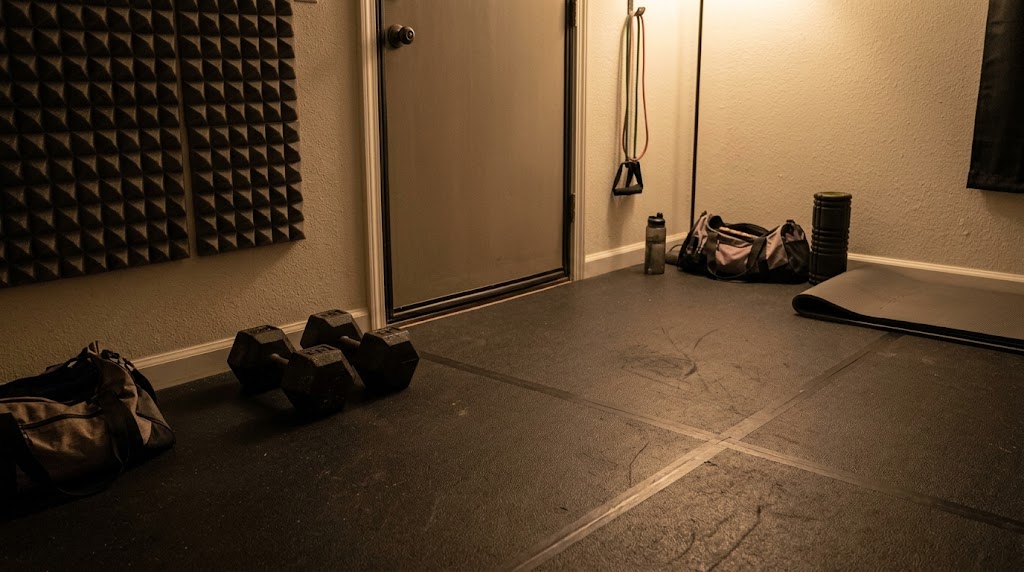
The two types of gym noise
Sound in a home gym travels two ways. Airborne noise is the sound that moves through the air: music, grunting, the clank of plates. Structure-borne noise is vibration that travels through the building: footfall from jumping, the impact of a dropped weight, the thud of a kettlebell returning to the floor. Neighbours below hear structure-borne noise far more than airborne noise, and it is the harder type to reduce.
Most noise complaints from home gyms are about impact. The person upstairs is not playing music too loud. They are doing burpees at 6 AM, and every landing transmits through the floor joists into the ceiling of the apartment below. Solving this problem requires mass, absorption, and separation between your equipment and the building structure.
Flooring: the first and most effective layer
We covered gym flooring materials in our flooring guide. For noise reduction specifically, the layered approach matters most:
Layer 1 (bottom): EVA foam tiles, 3/4 inch thick. These absorb vibration before it reaches the subfloor.
Layer 2 (top): Rubber mat, 3/8 to 3/4 inch thick. This provides a durable, stable surface for training and adds mass, which blocks sound transmission.
The combined thickness of 1.25 to 1.5 inches reduces impact noise by 40 to 60 percent compared to training on bare floor. For exercises with controlled placement (squats, presses, rows), this is sufficient. For dropped weights and high-impact jumping, you need more.
Crash pads for deadlifts and Olympic lifts
If you deadlift or clean at home, the bar returning to the floor is the loudest moment in your workout. Bumper plates help (rubber absorbs more than iron), but the real solution is a deadlift platform or crash pads. A pair of Silencer drop pads placed on either side of your stance absorbs the impact of a barbell landing from hip height. They are dense foam wrapped in vinyl and designed to take repeated heavy drops.
If crash pads are too expensive, stack two layers of horse stall mats (1.5 inches total rubber) in the drop zone. Not as effective as purpose-built pads, but dramatically better than bare gym flooring.
Wall and ceiling treatments
Mass-loaded vinyl (MLV)
A thin, heavy sheet material that adds mass to walls and ceilings. Mass blocks airborne sound. MLV weighs about 1 lb per sq ft and is typically installed behind drywall or under flooring. For a home gym, hanging MLV on the walls of your gym area (even loosely) reduces the airborne noise that escapes to adjacent rooms. Not practical for renters unless you can hang it like a curtain.
Acoustic foam panels
Foam panels (the egg-crate or pyramid-shaped tiles common in recording studios) absorb sound reflections within the room. They make the room sound quieter to you but do very little to prevent sound from leaving the room. They reduce echo, not transmission. Useful if your gym sounds like a concrete box but not a solution for neighbour noise.
Weatherstripping and door seals
Sound leaks through gaps. The gap under your gym door, around window frames, and through electrical outlets all let airborne sound escape. Adhesive weatherstripping on the door frame and a door sweep on the bottom are cheap, easy fixes that reduce the sound your gym sends into hallways and shared spaces. Total cost: under $20.
Equipment choices that reduce noise
Bumper plates vs iron plates
Rubber bumper plates are quieter than iron plates on every metric. They absorb impact when set down, do not clang against each other on the bar, and can be dropped from overhead without destroying the floor or the plates. If you lift heavy at home, bumper plates are not optional. They are the minimum standard for responsible apartment lifting.
Controlled movement instead of drops
The simplest noise reduction technique costs nothing: lower your weights instead of dropping them. A deadlift lowered over 2 seconds generates a fraction of the impact of a deadlift dropped from lockout. Romanian deadlifts, which never touch the floor, eliminate the impact entirely. Adjusting your exercise selection for your environment is not a compromise. It is intelligent training.
Timing
Train during hours when your neighbours are least bothered. Mid-morning to early evening on weekdays, mid-morning to afternoon on weekends. Avoid 6 to 7 AM unless you know your downstairs neighbour's schedule. A quiet conversation with your neighbour about your training schedule prevents 90 percent of complaints.
The realistic approach
Perfect soundproofing requires building a room within a room: decoupled walls, floating floor, sealed ceiling. That is a $5,000 to $15,000 construction project. For a home gym, the goal is not perfection. It is reducing impact noise enough to train without complaints and reducing airborne noise enough that your music stays in your space.
The priority order for most apartment gym users:
1. Double-layer flooring (foam under rubber): biggest impact for the money
2. Controlled lowering of weights: free
3. Bumper plates instead of iron: one-time equipment swap
4. Door seals and weatherstripping: $20 fix
5. Crash pads for deadlift zone: if you lift heavy
6. Wall treatment: only if airborne noise is a documented complaint
Bottom line
Soundproofing a home gym is about reducing impact, not eliminating all sound. Double-layer flooring handles most of the problem. Controlled lifting technique handles more. The rest is incremental improvement for specific issues. Talk to your neighbours, train during reasonable hours, and invest in flooring before anything else.