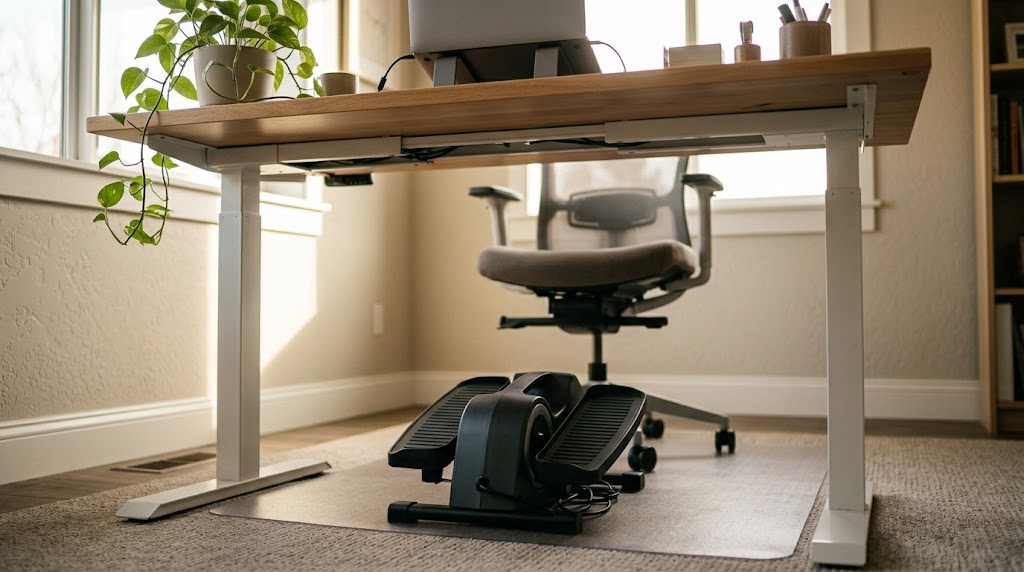
Why under-desk movement matters
Research published in the British Journal of Sports Medicine found that even a 30-minute gym session does not fully offset the health risks of prolonged sitting. What does help is breaking up sitting with low-intensity movement throughout the day. Under-desk equipment turns your work hours into movement hours without requiring you to leave your chair or lose focus on your screen.
The benefits are tangible: improved circulation in the legs, reduced lower back stiffness, higher daily calorie expenditure (typically 100 to 200 extra calories over an 8-hour day), and better focus. Several studies have found that light physical activity during cognitive tasks actually improves attention and problem solving, not the reverse.
The three categories
Under-desk ellipticals and pedal bikes
These are the most popular option. A compact elliptical or pedal system sits on the floor under your desk and you pedal while working. The movement is low impact, quiet at low resistance levels, and easy to do while typing or on video calls.
The Cubii JR1 Under-Desk Elliptical is the most well-known model in this category. It uses a seated elliptical motion rather than circular pedalling, which is smoother on the knees and easier to maintain at low speed without thinking about it. The built-in display tracks stride count, distance, and calories. At about $250, it is the premium option but also the quietest and smoothest.
For a budget alternative, a basic under-desk bike pedaller achieves similar results at a fraction of the cost. The trade offs are more noise at higher resistance and a less refined pedalling motion, but for gentle movement while answering emails, it does the job.
Balance boards
Balance boards work differently. Instead of repetitive motion, they create instability that forces your core, ankles, and small stabiliser muscles to work constantly. You stand on them while at a standing desk, and the micro-adjustments your body makes to stay balanced engage muscles that sitting leaves dormant all day.
A StrongTek balance board is built specifically for standing desk use. The rocker design is gentle enough to use all day without fatigue, the non-slip surface works with or without shoes, and the solid wood construction means it will outlast any plastic alternative. It is also completely silent, which matters if you work on calls frequently.
Balance boards are best paired with a standing desk. If you only have a sitting desk, the pedal-based options below are a better fit.
Foot rollers and massage bars
These are the simplest category. A textured roller under your feet provides gentle massage and encourages foot movement without any conscious effort. They do not burn many calories, but they relieve plantar fascia tension and keep blood circulating in the feet and lower legs.
A wooden foot roller costs under $15 and requires no electricity, no setup, and no noise. For office workers who already spend 8 hours in shoes, the difference in foot comfort by the end of the day is noticeable.
Comparison: which type fits your setup
| Feature | Under-Desk Elliptical | Pedal Bike | Balance Board | Foot Roller |
|---|---|---|---|---|
| Calorie burn (8 hr day) | 150 to 200 | 100 to 150 | 50 to 100 | Minimal |
| Noise level | Very quiet | Quiet to moderate | Silent | Silent |
| Works at sitting desk | Yes | Yes | No (standing only) | Yes |
| Works at standing desk | No | No | Yes | Yes |
| Core engagement | Minimal | Minimal | Significant | None |
| Setup required | Place on floor | Place on floor | Place on floor | Place on floor |
| Price range | $200 to $350 | $30 to $80 | $30 to $60 | $10 to $20 |
What to look for before buying
Desk clearance
Measure the height between the floor and the bottom of your desk. Under-desk ellipticals typically need 10 to 12 inches of clearance. Pedal bikes need less (8 to 10 inches). If your desk is low or non-adjustable, this measurement determines what will fit.
Noise
If you work on video calls, noise matters. The Cubii JR1 is rated under 35 decibels, which is quieter than a whisper. Budget pedal bikes at higher resistance can hit 50 to 60 decibels, which is noticeable on a mic. Balance boards and foot rollers are silent.
Resistance range
For pedal-based equipment, adjustable resistance lets you dial intensity up during focused solo work and down during calls. Look for at least 4 resistance levels. Some models also connect to apps via Bluetooth to track your daily movement.
Combining options
The best setup for remote workers is not a single device but a combination. A standing desk with a balance board for mornings, then switch to sitting with an under-desk pedaller for the afternoon. This alternates between core engagement while standing and leg circulation while sitting, covering the two biggest risks of desk work: a weak core and stagnant leg blood flow.
Track your daily movement and active minutes with a Fitbit Charge 6. It counts steps and active zone minutes even for low-intensity movement like pedalling and balance board work, which gives you tangible feedback that sitting-based activity actually registers.
What does not work
- Under-desk treadmills while sitting. They exist, but using a walking treadmill from a seated position is awkward and most are designed for standing desk use. If you have a standing desk, a walking pad is a separate category worth exploring.
- Resistance bands tied to your chair. This is a real product category and it is a bad idea. The movement interferes with typing, pulls your chair out of position, and provides inconsistent resistance that can strain your lower back.
- Ankle weights worn all day. They change your gait pattern, which can cause knee and hip problems over time. Ankle weights are for targeted exercises, not for wearing during an 8-hour work day.
The bottom line
Under-desk equipment will not replace a real workout. What it does is break the cycle of complete stillness that causes most of the health problems associated with desk work. A Cubii JR1 or a simple pedal bike under a sitting desk, a StrongTek balance board under a standing desk, or even a $15 foot roller adds movement to hours that were previously dead time. Over weeks and months, those hours compound into meaningfully better circulation, posture, and daily calorie burn with zero time taken away from work.