Important: This article is general fitness information, not medical advice. If you have an injury, consult a physiotherapist or doctor before training. They can tell you exactly which movements are safe and which to avoid for your specific condition.
The principle: train around, not through
Training through pain is how minor injuries become chronic problems. Training around an injury means you avoid any movement that causes pain in the injured area while continuing to train everything else.
This is not a compromise. Research consistently shows that maintaining activity during injury recovery leads to faster healing, better mental health, and less muscle and strength loss compared to complete rest. A 2019 study in the British Journal of Sports Medicine found that people who maintained some form of exercise during injury recovery returned to full training 23% faster than those who stopped completely.
Common injuries and what you can still do
Shoulder injury
Shoulder injuries (rotator cuff strains, impingement, bursitis) typically rule out overhead pressing, lateral raises, and heavy pulling movements. Everything below the shoulder is fair game.
Still safe in most cases:
- All lower body exercises: squats, lunges, deadlifts, leg press, calf raises
- Core work: planks, dead bugs, pallof press (if the band position does not stress the shoulder)
- Walking, cycling, or the under-desk elliptical for cardio
- Light band work for shoulder rehabilitation (internal and external rotation) if prescribed by your physio
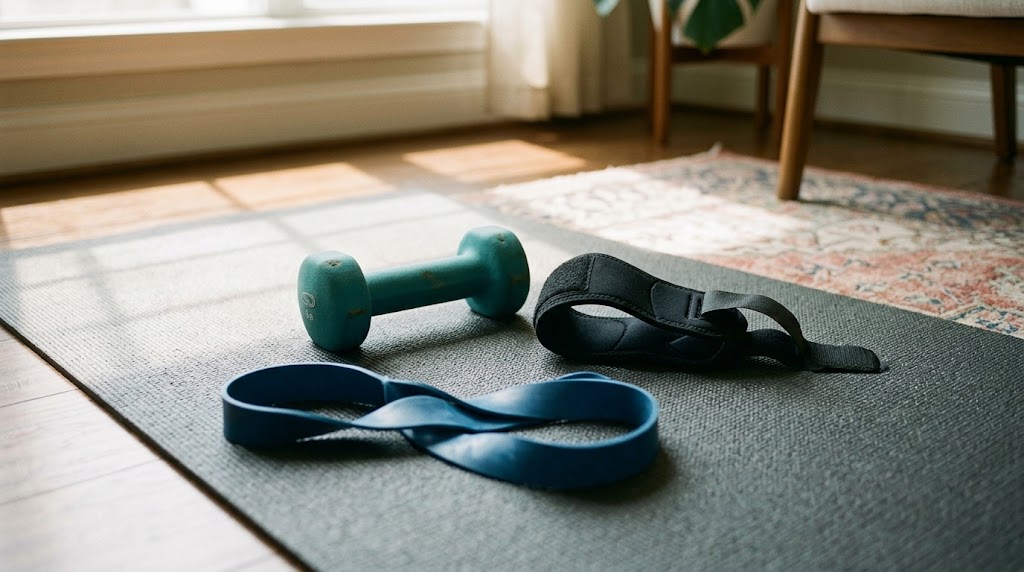
A resistance band set is particularly useful during shoulder recovery. Bands allow you to control the load precisely, work through pain-free ranges, and perform the rehab exercises your physiotherapist prescribes without needing to visit a gym.
Knee injury
Knee injuries (patellofemoral pain, meniscus issues, ligament sprains) typically rule out squats, lunges, and high-impact activities. Upper body and low-impact cardio remain available.
Still safe in most cases:
- All upper body work: pressing, rowing, curls, tricep extensions
- Core work: planks, crunches, pallof press, hanging leg raises (if grip does not stress the knee)
- Seated cardio: the Cubii JR1 under-desk elliptical allows pedalling with minimal knee flexion angle and zero impact
- Hip hinge movements that do not load the knee: band pull-throughs, glute bridges
Lower back injury
Lower back injuries require the most caution because the spine is involved in almost every compound movement. Avoid any exercise that causes pain, and be especially careful with spinal flexion (crunches, sit ups) and heavy axial loading (squats, overhead press).
Still safe in most cases:
- Supported upper body work: seated dumbbell press, incline bench press, machine-based exercises
- Walking (often recommended by physiotherapists as active recovery for low back pain)
- Gentle mobility work: cat-cow, pelvic tilts, knee-to-chest stretches
- Single-leg exercises with light weight (they load the spine less than bilateral exercises)
Recovery is critical during a back injury. A foam roller can provide gentle myofascial release for the muscles surrounding the spine (never roll directly on the spine itself). Use it on your glutes, hip flexors, and thoracic area to reduce the muscular tension that often accompanies low back pain.
Wrist or hand injury
Wrist injuries rule out gripping. That eliminates most dumbbell and barbell exercises but leaves everything that does not require your hands.
Still safe in most cases:
- All lower body exercises (goblet squat becomes bodyweight squat; dumbbell RDL becomes single-leg RDL with bodyweight)
- Core work: planks on forearms instead of hands, leg raises, pallof press with band around forearm
- Cardio: walking, cycling, elliptical, jump rope (if wrist allows the motion)
Resistance bands looped around the forearm instead of gripped in the hand can maintain upper body training through many wrist injuries. This is one of the most versatile modifications in injury training.
Equipment that supports injury training
Certain home gym equipment is especially useful when training around injuries because it offers precise load control, reduced impact, or alternative movement paths.
- Resistance bands: Progressive loading, infinite exercise variations, and the ability to adjust resistance mid-set. The single most versatile piece of injury training equipment.
- Adjustable dumbbells: Start at the lowest weight setting and increase gradually as the injury heals. The Bowflex 552 starts at 5 lbs per hand, light enough for most rehabilitation exercises.
- Foam roller: Gentle myofascial release for muscles surrounding the injured area. Never roll directly on the injury site.
- Under-desk elliptical: Zero-impact cardio that maintains cardiovascular fitness during lower body injuries.
- Fitness tracker: Monitor your resting heart rate and activity levels to ensure you are maintaining a baseline of fitness during recovery without overtraining.
Mental side of training injured
The hardest part of training around an injury is not physical. It is watching yourself do less than you could do last month. Lifting lighter weights, skipping exercises you enjoy, and accepting temporary limitations challenges your identity as a fit person.
Two reframes that help:
- Maintenance is a win. If you come out of a 6-week injury period having maintained 90% of your muscle mass, cardiovascular fitness, and training habit, that is a massive success. Most people lose all three.
- It is temporary. The vast majority of common training injuries heal within 4 to 12 weeks. That is a small window in a lifetime of training. What matters is that you are still in the game when it heals.
When to stop completely
There are situations where any training is a bad idea:
- Your doctor or physiotherapist has explicitly told you to rest completely
- The injury involves a fracture, severe ligament tear, or post-surgical recovery in the early stages
- You cannot perform any exercise without pain radiating from the injured area
- You are taking pain medication that masks symptoms (you cannot trust your body's feedback)
In these cases, rest is not giving up. It is the training programme.