What changes after 40
Between the ages of 30 and 80, the average person loses 30 to 40% of their muscle mass if they do nothing about it. The medical term is sarcopenia, and after 40 the rate of loss accelerates to roughly 1% per year. That translates directly to reduced metabolism, weaker bones, poorer balance, and higher injury risk from everyday activities.
The good news is that resistance training reverses this process at any age. A meta-analysis published in Medicine & Science in Sports & Exercise found that adults over 50 who performed progressive resistance training gained an average of 1.1 kg of lean muscle mass over 20 weeks. You do not need a gym membership to get these results. You need the right equipment, the right approach, and the patience to let your body adapt.
Joint protection comes first
The biggest difference between training in your 20s and training after 40 is joint tolerance. Tendons and ligaments lose elasticity with age, and cartilage thins. Movements that felt fine at 25 can produce nagging aches at 45 if you load them the same way.
This does not mean you avoid heavy lifting. It means you choose exercises that load joints in their strongest positions and avoid unnecessary stress at end range under load.
Smart swaps for common exercises
| Instead of | Try | Why |
|---|---|---|
| Barbell back squat | Goblet squat with dumbbell | Less spinal compression, easier to maintain upright posture |
| Barbell bench press | Dumbbell floor press | The floor limits range, protecting the shoulder joint at the bottom position |
| Deadlift from floor | Romanian deadlift with dumbbells | Reduces lower back strain while still training the posterior chain |
| Behind the neck press | Neutral grip dumbbell press | Less shoulder impingement risk |
| Plyometric box jumps | Step ups with dumbbells | Same muscles, zero impact on landing |
Equipment that respects your body
At home, your equipment choices make a significant difference when you are training around aging joints.
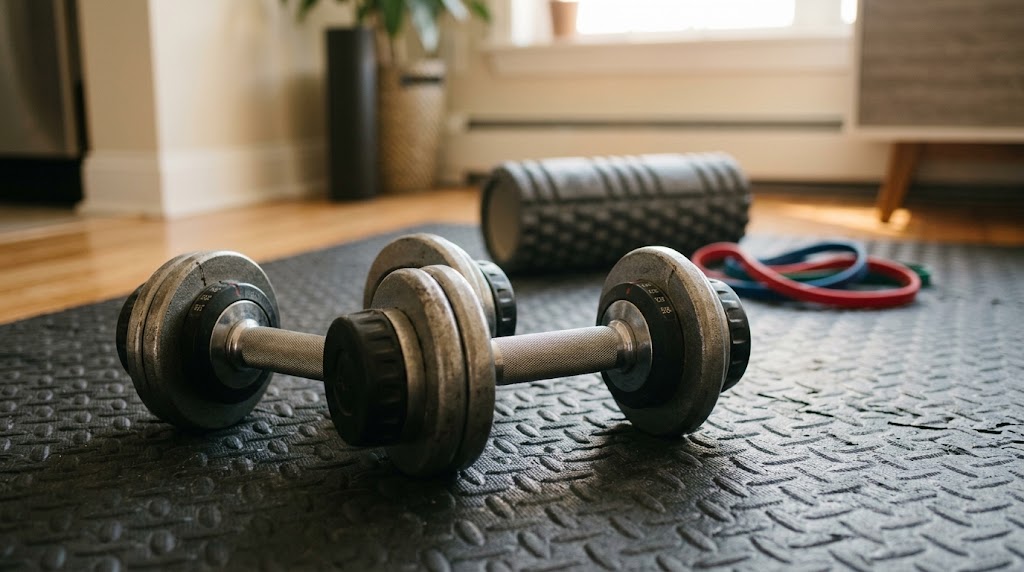
Adjustable dumbbells let you increase weight in small increments, which is critical for progressive overload without jumping 10 lbs at a time. The Bowflex SelectTech 552 adjusts in 2.5 lb increments from 5 to 52.5 lbs, which is exactly the kind of granularity you need when a 5 lb jump aggravates a shoulder but 2.5 lbs is fine.
Resistance bands are underrated for over-40 training. They provide accommodating resistance, which means the load is lightest at the bottom of a movement (where joints are most vulnerable) and heaviest at the top (where muscles are strongest). A set of resistance bands with handles gives you enough variety for a full programme.
A foam roller is not optional at this age. Myofascial release before and after training improves range of motion and reduces the kind of stiffness that makes you feel 60 when you are 45. The high-density foam roller is firm enough to be effective without being so hard that it bruises.
Tracking recovery becomes more important with age. A Fitbit Charge 6 monitors your resting heart rate and sleep quality, both of which are reliable indicators of whether your body has recovered enough to train again. If your resting heart rate is elevated 48 hours after a session, you probably need another rest day.
Programming for over 40
The principles of progressive overload do not change with age. What changes is the rate of progression and the recovery time between sessions.
Frequency
Three training days per week is the sweet spot for most people over 40. This gives you at least one full rest day between every session, which your tendons and joints need more than your muscles do. Muscles recover in 24 to 48 hours. Tendons and connective tissue can take 48 to 72 hours.
Volume
Two to three sets per exercise is plenty. The research shows that 80% of the muscle building stimulus comes from the first two to three hard sets. Going beyond that adds fatigue without proportional benefit, which is a bad trade off when recovery is already slower.
Progression
Add reps before adding weight. Once you can complete all prescribed reps with good form for two consecutive sessions, increase the weight by the smallest increment available and drop back to the lower end of the rep range. This keeps the load on your muscles and off your joints.
Sample weekly structure
| Day | Focus | Duration |
|---|---|---|
| Monday | Upper body (push and pull) | 35 to 40 min |
| Tuesday | Rest or light walking | 20 to 30 min walk |
| Wednesday | Lower body and core | 35 to 40 min |
| Thursday | Rest or mobility work | 15 to 20 min foam rolling |
| Friday | Full body (moderate intensity) | 30 to 35 min |
| Weekend | Active recovery (walking, stretching) | As desired |
Warm up is not optional
At 25 you could walk into a gym cold and start benching. At 45 that is a recipe for a pulled muscle or a tweaked joint. Every session should start with 5 to 10 minutes of general warm up followed by warm up sets with lighter weight before your working sets.
A RENPHO smart jump rope at light pace for 3 to 5 minutes raises your core temperature and lubricates your joints without taxing your energy for the main workout. Follow it with dynamic stretches targeting the muscles you plan to train.
Nutrition matters more now
Protein synthesis becomes less efficient with age, which means you need to eat more protein per meal to stimulate the same muscle building response as a younger person. Research suggests that adults over 40 should aim for 0.7 to 1 gram of protein per pound of bodyweight daily, with at least 30 to 40 grams per meal to hit the leucine threshold that triggers muscle protein synthesis.
Hydration and sleep are the other two pillars. Dehydration impairs strength output by up to 10%, and poor sleep reduces testosterone production and growth hormone release, both of which are already declining with age.
What to watch for
- Sharp joint pain during a movement: Stop immediately. Dull muscular ache is normal. Sharp pain in a joint is not. Swap the exercise for a band variation that loads the same muscle pattern without the joint stress.
- Persistent soreness lasting more than 72 hours: You are doing too much volume or not recovering enough. Drop a set from every exercise next session.
- Strength plateaus lasting more than three weeks: Deload for one week at 50% of your normal weight, then resume. Your connective tissue often needs a break before your muscles do.
The bottom line
Strength training after 40 is not a modified version of what young people do. It is its own discipline, with its own priorities: joint health, recovery management, and sustainable progression. The payoff is enormous. Stronger bones, better balance, higher metabolism, and a body that works the way you need it to for the next 40 years. You do not need a gym. You need a set of dumbbells, some bands, a foam roller, and the discipline to show up three times a week.