Smart does not have to mean expensive
When people hear "smart home gym," they picture a $3,000 Peloton bike or a $2,500 connected fitness mirror. Those products exist, and some of them are good. But you can build a smart, connected home gym setup for under $300 that tracks your workouts, monitors your health metrics, and keeps you accountable without a monthly subscription fee eating into the value.
The key is buying smart where it matters and basic where it does not. A dumbbell does not need Bluetooth. Your heart rate monitor does.
Smart tracking: know what you are actually doing
The single most impactful "smart" purchase for home fitness is a wrist-based tracker. The Fitbit Charge 6 tracks heart rate, steps, calories, sleep quality, and active minutes. It connects to the Fitbit app, which shows you weekly and monthly trends that a mirror or a scale cannot.
Why this matters for home training specifically: when you train at a gym, the environment cues you to work hard. Other people are watching. The equipment is right there. At home, it is easy to go through the motions without actually pushing yourself. A heart rate tracker gives you objective data on whether your "intense" HIIT session was actually intense or just felt that way.
At around $100, the Charge 6 is the most cost-effective way to add genuine intelligence to your home workouts.
Smart cardio: connected without the price tag
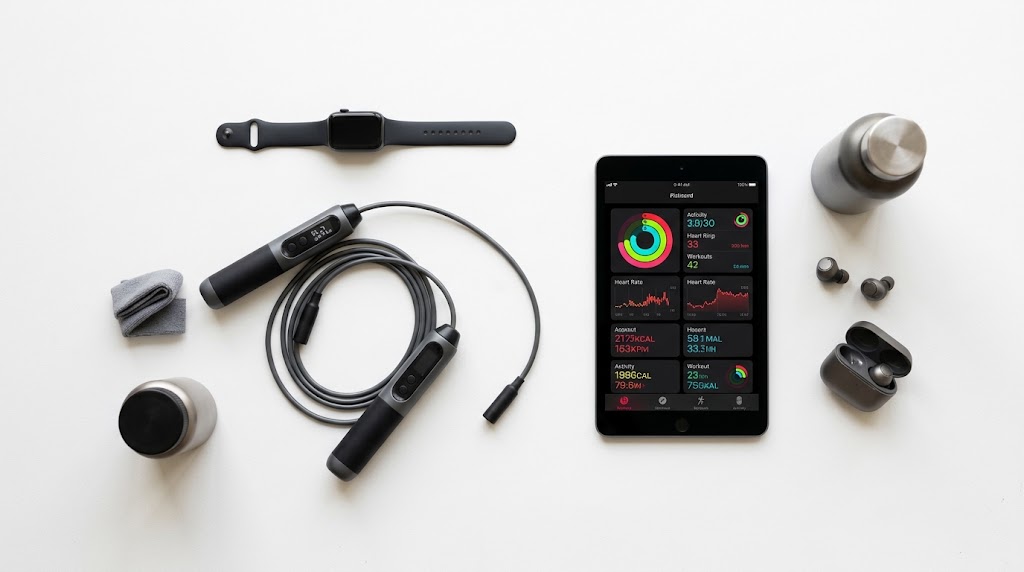
The RENPHO smart jump rope counts your skips, tracks workout duration, and syncs the data to your phone. Jump rope is one of the highest calorie-per-minute exercises you can do, and having your rep count tracked means you can set targets and measure progress instead of just skipping until you are tired.
At under $30, it is one of the cheapest ways to add a connected cardio option to your apartment gym. And it stores in a drawer.
For low-impact smart cardio, the Sunny Health foldable X-Bike connects to fitness apps via Bluetooth and folds flat for storage. It is not a $1,500 spin bike, but it tracks your cadence, distance, and resistance level, which is all you need for effective training at home.
If your apartment is tight on space but you want a walking option, the Sperax walking pad displays speed, distance, time, and calories on a small LED panel. It does not have app connectivity, but it does fold in half and slide under your bed.
For under-desk movement during work hours, the Cubii JR1 elliptical tracks strides and calories through its companion app. It fits under any standard desk and runs silently.
A smart setup under $300
Here is a practical shopping list:
| Item | Smart Feature | Approximate Price |
|---|---|---|
| Fitbit Charge 6 | Heart rate, steps, sleep, app integration | $100 |
| RENPHO smart jump rope | Rep counting, duration tracking, app sync | $30 |
| Sunny Health X-Bike | Bluetooth, cadence tracking, app compatible | $150 |
Total: approximately $280. That gives you wrist-based health tracking, a connected cardio tool, and a foldable bike with smart features. No subscription fees required for basic functionality.
Alternatively, swap the X-Bike for a Cubii JR1 (roughly $250) if you want under-desk movement during work hours instead of dedicated cycling sessions. The total goes slightly over $300, but the Cubii integrates into your workday rather than requiring a separate exercise block.
What "smart" actually buys you
The value of connected fitness gear is not the gadgetry. It is the data and the accountability. When your Fitbit shows you that you only hit 4,000 steps on a Tuesday, you know to get on the walking pad Wednesday. When the RENPHO app shows your jump rope count climbing from 500 to 800 to 1,200 over three weeks, that is visible progress. Progress you can see is progress you keep making.
The opposite is also true: expensive smart equipment that you do not check the data on is just expensive equipment. A $3,000 connected bike is not smarter than a $150 X-Bike if you never open the app.
Where to spend more later
If your budget grows, the upgrades worth considering are:
- A Schwinn IC4 indoor cycling bike (around $800) for serious cycling with power measurement and Peloton app compatibility.
- A Speediance Gym Monster for a full cable-machine experience with smart resistance tracking in a compact frame.
But start with the basics. A Fitbit, a smart rope, and an affordable connected bike or under-desk elliptical give you a solid smart home gym foundation that costs less than three months of a commercial gym membership.