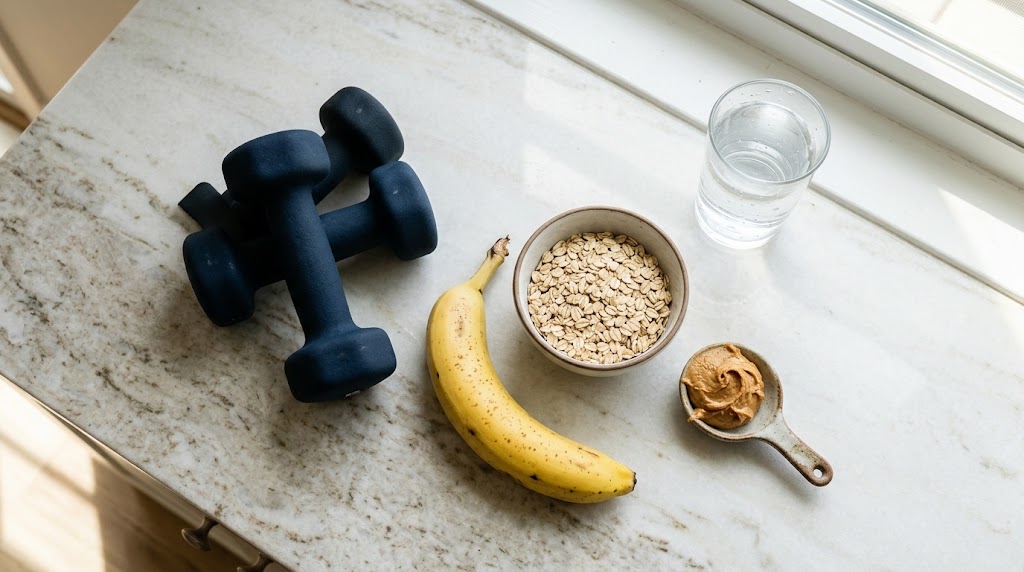
What pre-workout nutrition actually does
Your body runs on glycogen (stored carbohydrate) and fat during exercise. For strength training and high-intensity cardio, glycogen is the primary fuel source. When glycogen stores are low, your performance drops: fewer reps, less power output, earlier fatigue, and worse concentration.
Pre-workout nutrition tops off your glycogen stores and provides readily available glucose for the work ahead. It is not about eating a "superfood." It is about having fuel in the tank.
Timing: the three windows
How much and what you eat depends on how long before training you eat it.
2 to 3 hours before: a full meal
If you train in the late morning or evening and can eat a proper meal 2 to 3 hours beforehand, this is the ideal scenario. The meal has time to digest fully, blood sugar is stable, and glycogen stores are topped off.
What to eat: A balanced meal with complex carbohydrates, moderate protein, and some fat. Think rice and chicken, pasta with lean meat sauce, or a sandwich with turkey and vegetables. Nothing exotic. Just real food in normal portions.
Portion size: Whatever you normally eat at that meal. Pre-workout nutrition is not about eating extra. It is about ensuring that your regular eating schedule aligns with your training schedule.
60 to 90 minutes before: a smaller meal or large snack
If your schedule puts training sooner after eating, reduce the portion and shift toward faster-digesting carbohydrates.
What to eat: Oatmeal with banana, toast with peanut butter, yogurt with granola, or a smoothie. Lower fat and fibre than a full meal, because both slow digestion and can cause discomfort during training.
15 to 30 minutes before: quick energy only
This is the "I train first thing in the morning" window or the "I forgot to eat" window. You do not have time to digest a meal. You need fast-acting glucose.
What to eat: A banana, a handful of dates, a sports drink, or a small glass of juice. Simple sugars that hit the bloodstream quickly. This is not the time for complex meals, protein, or fibre.
Training fasted: is it fine?
Short answer: for most home workouts, yes. Fasted training is not optimal for peak performance, but for a 30 to 45 minute home session at moderate intensity, the performance difference is small enough that many people will not notice it.
Where fasted training genuinely hurts performance:
- Sessions longer than 60 minutes
- High-intensity interval training (HIIT)
- Heavy strength training focused on maximal loads
- Any session where you want to set personal records
Where fasted training works fine:
- Light to moderate cardio (walking, cycling, under-desk elliptical)
- Short bodyweight circuits (20 to 30 minutes)
- Flexibility and mobility sessions
- Foam rolling and recovery work
If you prefer training first thing in the morning without eating, that is a valid choice. Just keep a banana nearby in case your energy drops mid-session.
The home training advantage: your kitchen is right there
Gym goers have to plan their pre-workout meal, prepare it, transport it, or stop at a shop on the way. Home trainers walk to the kitchen. This makes several things easier:
- Smoothies before early sessions. Blend frozen banana, oats, milk, and a scoop of protein powder 15 minutes before training. It takes 90 seconds to make and digests quickly enough to fuel a session that starts within 20 minutes.
- Oatmeal during the work day. If you train at lunch, make oatmeal at 11 AM. By 12:30, it has digested and your glycogen is ready. You do not need to meal prep or carry containers.
- Post-workout meal in minutes. Training at home means you eat within 15 minutes of finishing. At a gym, you have to shower, drive home, and then eat. That delay matters less than people think for muscle building, but it matters for hunger and energy for the rest of your day.
Pre-workout supplements: what the research says
Caffeine
Caffeine is the most evidence-supported ergogenic aid in sports nutrition. A dose of 3 to 6 mg per kilogram of bodyweight, taken 30 to 60 minutes before training, consistently improves strength output, endurance, and perceived effort across hundreds of studies. For a 75 kg person, that is 225 to 450 mg, roughly equivalent to 2 to 4 cups of coffee.
You do not need a pre-workout supplement for caffeine. A cup of coffee or tea works identically. The caffeine molecule does not care whether it came from a $40 tub of powder or a $0.20 tea bag.
Creatine
Creatine monohydrate is the most researched supplement in sports science. It increases your muscles' phosphocreatine stores, which provides energy for short, high-intensity efforts (heavy lifts, sprints, explosive movements). A dose of 3 to 5 grams daily has been shown to improve strength, power output, and muscle gain in hundreds of studies.
Creatine does not need to be timed pre-workout specifically. It builds up in your system over days and weeks. Taking it at any consistent time works. Many people add it to their post-workout protein shake for convenience.
Pre-workout powders
Most commercial pre-workout supplements are a combination of caffeine, beta-alanine (causes the tingling sensation), citrulline (may improve blood flow), and various other ingredients in doses that may or may not be clinically effective. The primary active ingredient in nearly all of them is caffeine.
If you respond well to a specific pre-workout and the cost is acceptable, there is nothing wrong with using it. But you can replicate the meaningful effects with coffee and creatine monohydrate at a fraction of the price.
Quick reference: pre-workout meals by training time
| When You Train | When to Eat | What to Eat |
|---|---|---|
| 6 AM (fasted) | Optional: banana at 5:45 | Quick fruit or nothing |
| 7 AM (after waking) | 6:30 AM | Smoothie or toast with honey |
| 12 PM (lunch break) | 10 to 10:30 AM | Oatmeal, yogurt with granola |
| 5 PM (after work) | Normal lunch at 12 to 1 PM | Regular balanced meal |
| 8 PM (evening) | Normal dinner at 6 PM | Regular balanced meal |
What not to eat before training
- High-fat meals within 60 minutes: Fat slows digestion. A greasy meal sitting in your stomach during squats is a mistake you make once.
- Large amounts of fibre within 60 minutes: Fibre is excellent for health but terrible for comfort during training. Save the big salad for after.
- Unfamiliar foods: The morning of a hard training session is not the time to try a new supplement, a new food, or a large amount of something your stomach is not used to.
- Nothing at all (for intense sessions): If you are planning a heavy strength session or a long HIIT workout, eat something. Even a banana is better than nothing.
Track what works for you
Nutrition is individual. Some people train brilliantly fasted. Others feel terrible without a full meal two hours before. The only way to find your pattern is to pay attention. A Fitbit Charge 6 can help here: compare your active zone minutes, heart rate recovery, and workout duration across different pre-workout meals to see if nutrition makes a measurable difference in your performance data.