Recovery is not optional
You do not get stronger during a workout. You get stronger between workouts, when your body repairs the muscle fibres you just stressed. Skip recovery, and you are just accumulating fatigue without giving your body the signal to adapt. That leads to plateaus, persistent soreness, and eventually injury.
The good news: effective recovery does not require a sports clinic or an hour of your time. Ten to fifteen minutes of targeted work after each session, using tools that fit in a drawer, makes a measurable difference.
Immediate post-workout: cool down and stretch
Walk around your apartment for two to three minutes after your last set. This brings your heart rate down gradually instead of slamming from intense effort to sitting on the couch.
Then stretch the muscles you just worked. A Trideer stretching strap makes this easier by giving you fixed loops to hold, so you can ease into a stretch without forcing it. Focus on:
- Hamstrings: Lie on your back, loop the strap around one foot, and gently pull the leg toward you with the knee straight. Hold 30 seconds per side.
- Hip flexors: Half-kneeling lunge position, tuck your pelvis under and lean forward slightly. These tighten dramatically from desk work.
- Shoulders and chest: Thread one arm through a doorframe and rotate your body away gently. Hold 30 seconds per side.
Five minutes of targeted stretching after training is worth more than 30 minutes of random stretching on a rest day.
Foam rolling: the self-massage that works
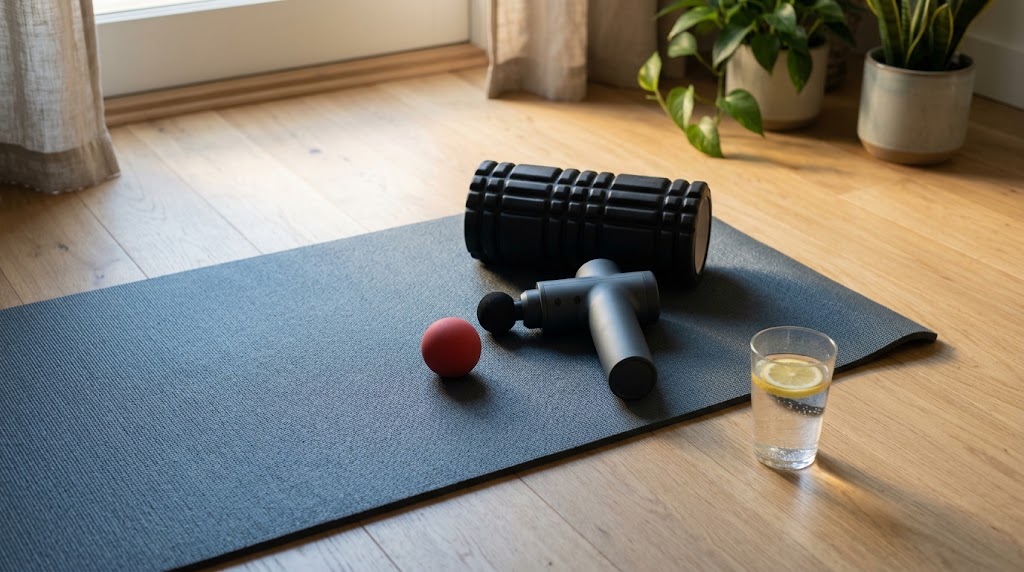
A 321 STRONG foam roller applies pressure to tight muscle tissue in a way that increases blood flow and reduces post-exercise stiffness. The research supports it: a 2019 meta-analysis in Frontiers in Physiology found that foam rolling after exercise reduces delayed-onset muscle soreness (DOMS) at 24, 48, and 72 hours post-workout.
Roll slowly over each target area. When you find a tender spot, pause on it for 20 to 30 seconds. The most productive areas for most home trainers:
- Quads and IT band (after squats, lunges, or walking pad sessions)
- Upper back and thoracic spine (after pressing or rowing)
- Glutes and piriformis (after any lower body work)
- Calves (after walking pad or skipping rope sessions)
Percussion therapy for deeper work
A foam roller works on broad muscle groups. For specific knots and trigger points, a Theragun Mini reaches spots the roller cannot. It is particularly useful on the forearms (after dumbbell or kettlebell work), the traps (after overhead pressing), and the plantar fascia (the bottom of your foot, especially if you run or use a stepper).
The Mini fits in a nightstand drawer and runs for 150 minutes on a single charge. Two to three minutes per target area is enough. More is not better with percussion therapy; you are trying to increase blood flow and release tension, not bruise yourself.
Your recovery surface matters
Stretching and foam rolling on a hard floor is uncomfortable and limits how much pressure you can apply effectively. A Manduka PRO yoga mat gives you a cushioned, non-slip surface that is thick enough to be comfortable on your knees and elbows. It rolls up to about 10 inches in diameter for storage.
For yoga-specific stretching and recovery flows, a Manduka cork yoga block supports your body in poses where your flexibility is not yet sufficient to reach the floor comfortably. It is more stable than foam blocks and lasts significantly longer.
Building a recovery habit
The biggest obstacle to recovery is not equipment or knowledge. It is that people treat it as optional. They finish their last set, feel good from the endorphins, and move on with their day.
Make recovery part of your workout, not something that happens after it. When you plan a 30-minute dumbbell session, plan it as 25 minutes of training and 5 minutes of rolling and stretching. When you write it into the session itself, it happens.