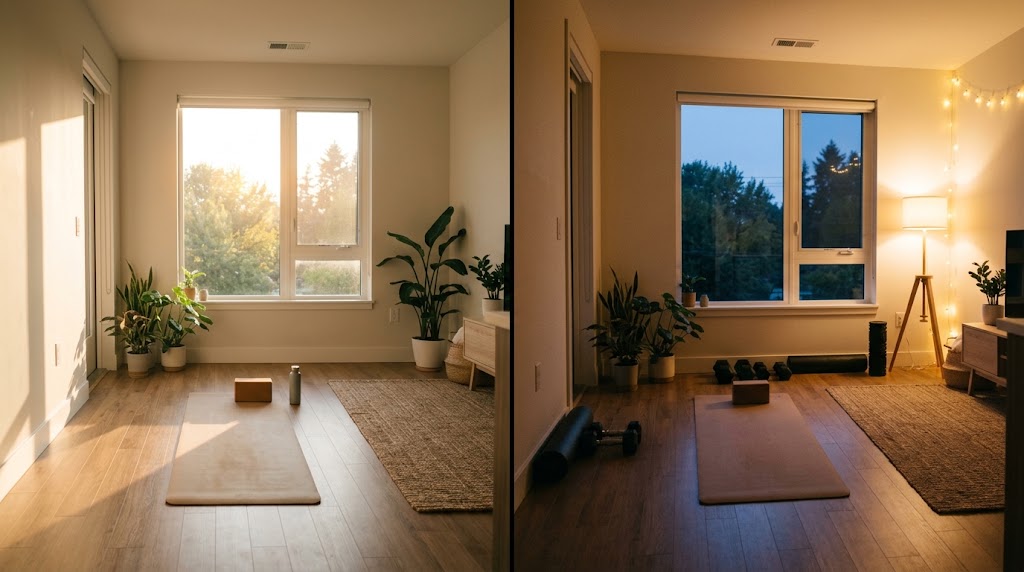
Why timing matters more than you think
Your body runs on a 24 hour internal clock called the circadian rhythm. It controls when your core temperature peaks, when your hormones surge, and when your muscles are most ready to produce force. Training in sync with these cycles does not turn a mediocre workout into an elite one, but it does give you a measurable advantage in strength, endurance, and recovery.
For home training specifically, timing also affects something less scientific but equally important: whether you actually follow through. When you train at a gym, you have a commute that commits you. At home, the sofa is five steps away. Choosing the right time window means choosing when your willpower and energy align.
The case for morning workouts
Morning training has one massive advantage that no hormone study can overrule: consistency. Research published in the Journal of Physiology found that people who exercise in the morning are more likely to maintain a long term habit than those who train in the evening. The reason is simple. Mornings have fewer competing demands. Nobody schedules a dinner, a late meeting, or a social event at 6 AM.
From a hormonal perspective, cortisol peaks in the first 30 to 60 minutes after waking. Cortisol gets a bad reputation, but in the context of exercise it is useful. It mobilises energy stores and helps your body transition from rest to activity. Testosterone also peaks in the morning, which supports muscle protein synthesis and strength output.
Morning workouts have been shown to improve sleep quality. A study from Appalachian State University found that participants who exercised at 7 AM experienced deeper sleep cycles and spent up to 75% more time in the most restorative stages of sleep compared to those who trained in the afternoon or evening.
The trade off is performance. Your core body temperature is at its lowest point in the morning, and cold muscles produce less force. If you are doing heavy strength work, you will likely need a longer warm up to reach the same output you would hit naturally at 5 PM.
A Fitbit Charge 6 is useful here. Tracking your resting heart rate over time reveals whether morning sessions genuinely suit your body or if you are consistently under-recovered when you train early.
The case for evening workouts
If raw performance is your priority, the research favours evening training. Your core body temperature peaks between 4 PM and 7 PM, and warmer muscles contract more forcefully and are less prone to injury. Studies have shown that strength output can be 5 to 10% higher in the late afternoon compared to early morning.
Reaction time, joint flexibility, and perceived exertion all improve later in the day. That HIIT session that feels brutal at 6 AM often feels more manageable at 6 PM, not because it is easier, but because your body is physiologically primed for effort.
Evening training also provides a stress release valve after the workday. For remote workers especially, a workout session between closing the laptop and starting the evening creates a physical boundary that separates work mode from personal time.
The main risk with evening exercise is sleep disruption. High intensity training within two hours of bedtime can elevate your heart rate and core temperature enough to delay sleep onset. Moderate intensity work like yoga, stretching, or steady state cycling does not carry the same risk. If you train late, low impact options like the Sunny Health foldable X-Bike let you get a session in without spiking your heart rate before bed.
What the research actually says
| Factor | Morning (6 to 9 AM) | Evening (4 to 7 PM) |
|---|---|---|
| Strength output | Lower (muscles are cold) | 5 to 10% higher |
| Consistency | Higher (fewer schedule conflicts) | Lower (life gets in the way) |
| Cortisol | Naturally elevated, supports energy | Lower, less stress response |
| Testosterone | Peak levels | Moderate levels |
| Core temperature | Lowest of the day | Peak (optimal for performance) |
| Sleep impact | Improves deep sleep | High intensity can delay sleep |
| Injury risk | Slightly higher without warm up | Lower (joints are more flexible) |
Practical guidelines for home training
If you are a morning person and your goal is fat loss or general fitness, train in the morning. The consistency advantage outweighs the small performance deficit, and the metabolic boost helps you start the day with energy.
If you are chasing strength gains or muscle growth, and your schedule allows it, train in the late afternoon or early evening. The higher core temperature and better neuromuscular coordination mean you can safely push harder.
If your schedule is unpredictable, pick whichever window you can protect from interruptions. A mediocre 6 AM workout that actually happens beats a theoretically perfect 5 PM session you skip three times a week.
Morning training tips
- Spend at least 10 minutes warming up. Dynamic stretches, bodyweight squats, and arm circles bring your core temperature up.
- Have water and a small snack (banana, handful of nuts) 20 to 30 minutes before training if you cannot exercise fasted.
- Lay out your workout clothes the night before. Reducing friction makes it harder to skip.
- Use a RENPHO smart jump rope as a warm up tool. Three to five minutes of jumping raises your heart rate and warms up your entire body faster than static stretching.
Evening training tips
- Finish high intensity work at least 90 minutes before bedtime.
- If you train after 8 PM, stick to moderate intensity: yoga, mobility work, or steady state cycling.
- Avoid pre-workout caffeine after 3 PM. It has a half life of 5 to 6 hours and will interfere with sleep.
- Use your post-workout window for recovery. A foam roller session after an evening workout helps your nervous system shift into recovery mode.
Tracking what works for you
The science gives averages, but you are not an average. Some people genuinely perform better in the morning despite what population studies suggest. The only way to know is to test both windows for two to three weeks each and compare the data.
Track your resting heart rate, sleep quality, and workout performance across both periods. A wrist-based tracker like the Fitbit Charge 6 captures all three automatically. After a few weeks, the data will show you which timing produces better recovery scores and higher workout output.
The bottom line
Morning workouts win on consistency and sleep quality. Evening workouts win on raw performance and injury prevention. Neither is objectively better. The best time to train at home is the time that fits your life, your energy patterns, and your goals. Pick one, protect it from interruptions, and stay with it long enough to build a habit. That matters more than any hormonal advantage.