Why meal prep equipment matters for fitness goals
You can train perfectly five days a week and make zero progress if your nutrition is wrong. Meal prep is not about eating chicken and broccoli in plastic boxes. It is about removing the daily decision of what to eat, which eliminates the most common failure point in any fitness programme: the 6 PM "I'm tired, let's order takeaway" moment.
The equipment for meal prep is simple and cheap. Containers that stack, seal, and survive a microwave. A scale that reads in grams. A few reusable bags for snacks. The total cost is under $50, and it pays for itself in the first week by replacing three or four takeaway orders.
Meal prep containers: glass vs plastic
Glass containers
Bayco glass meal prep containers are the standard recommendation for good reason: borosilicate glass does not absorb stains or odours, survives thousands of microwave cycles without warping, and cleans completely in a dishwasher. A 10-piece set (5 containers with lids) covers a standard 5-day meal prep cycle.
The downsides are weight and fragility. Glass containers weigh 2 to 3 times more than plastic equivalents. If you carry lunch to an office daily, that extra weight in a bag matters. And glass breaks if you drop it on a tile floor. For home use and short commutes, glass is the better long-term choice. For travel and gym bags, plastic has practical advantages.
Plastic containers
BPA-free polypropylene containers are lighter, cheaper, and nearly unbreakable. They stain from tomato sauce, absorb garlic odour over time, and warp in the microwave after 6 to 12 months of heavy use. They are also less environmentally friendly because they degrade faster and need replacing more often.
If you choose plastic, look for containers rated microwave-safe and dishwasher-safe on both the container and the lid. Some brands rate the container for microwave but not the lid, which means you remove the lid every time you reheat. It is a small inconvenience that becomes annoying 200 times a year.
Compartment containers
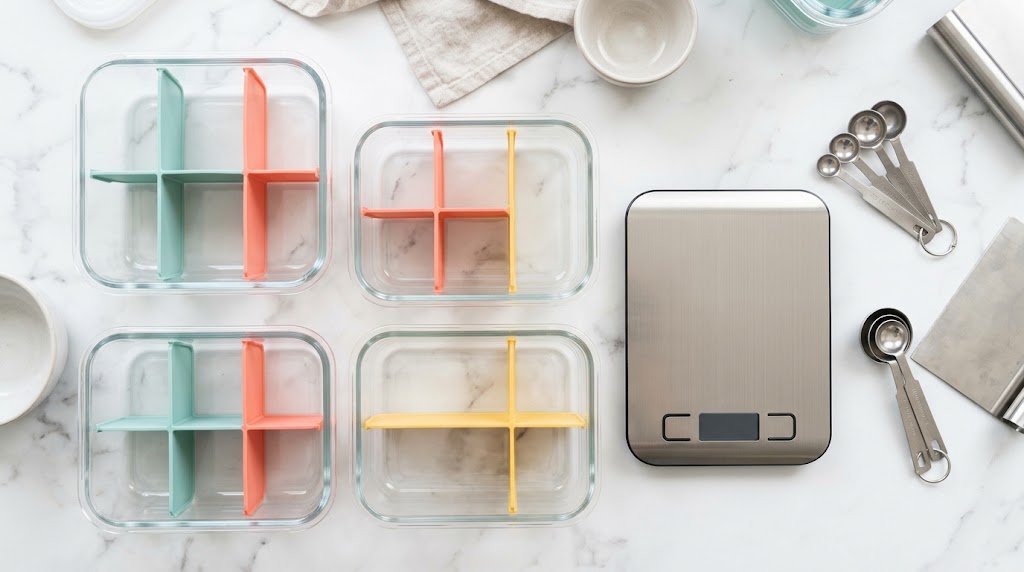
Divided containers (2 or 3 compartments) keep protein, carbs, and vegetables separate. This prevents soggy rice from a wet curry, keeps salad greens crisp next to warm chicken, and makes portion control visual. The trade-off is that compartment containers are harder to clean and do not stack as neatly as single-compartment boxes.
Kitchen scales: the most underused fitness tool
A kitchen scale eliminates the guesswork from portions. "A chicken breast" can be 4 oz or 10 oz depending on the bird. "A cup of rice" varies by 30 percent depending on how tightly you pack it. Weighing food in grams gives you a consistent, repeatable measurement that makes calorie tracking accurate rather than approximate.
The Etekcity kitchen scale reads to 1 gram, supports up to 11 lbs, runs on 2 AAA batteries, and has a tare function for weighing food in a bowl. It is the most recommended kitchen scale across fitness and cooking communities because it does exactly what is needed for $12 to $15.
Features that matter
Tare function: Place a bowl on the scale, press tare, and the display resets to zero. Now weigh your food in the bowl without doing subtraction. Every decent scale has this. If yours does not, replace it.
Unit switching: Toggle between grams, ounces, pounds, and millilitres. Grams are the standard for nutrition tracking because food labels and apps (MyFitnessPal, Cronometer) use grams as the base unit.
Platform size: A platform at least 5 by 6 inches fits standard dinner plates and mixing bowls without the edges hanging over and destabilising the reading.
Battery life: AAA or CR2032 batteries last 6 to 12 months with daily use. Rechargeable USB scales exist but add cost and charge management for no practical benefit at this price point.
A simple meal prep workflow
Sunday afternoon, 90 minutes:
1. Cook 2 to 3 lbs of protein (chicken thigh, ground turkey, or beef). Season simply. Bake at 400F for 25 to 30 minutes.
2. Cook 3 to 4 cups of dry rice or roast 2 to 3 lbs of potatoes. Carb base for the week.
3. Roast 2 to 3 lbs of mixed vegetables (broccoli, peppers, sweet potato, zucchini) on a sheet pan. 20 minutes at 425F.
4. Weigh portions into containers: 150 to 200g protein, 150 to 200g carbs, 150g vegetables per meal. Adjust macros to your specific calorie target.
5. Stack in the fridge. Meals 1 to 3 go in the front row (eat first). Meals 4 to 5 go behind or in the freezer.
Total cost: $25 to $40 for 5 complete meals. Compare that to 5 takeaway lunches at $12 to $18 each.
Storage and organisation
Meal prep only works if the containers stack efficiently in your fridge. Square or rectangular containers use shelf space better than round ones. Same-brand containers stack more neatly than mixed brands. A dedicated fridge shelf for prepped meals makes the system visible and reduces the chance of forgetting meals at the back.
Pair containers with reusable snack bags for portioned nuts, protein powder, and cut fruit. These replace the daily plastic bag and reduce kitchen waste over hundreds of uses.
Bottom line
Meal prep is the unsexy part of fitness that produces the most consistent results. A set of glass containers, a kitchen scale, and 90 minutes on Sunday replaces 5 takeaway orders, saves $40 to $60 per week, and removes the daily nutrition decision that derails most training programmes. The equipment costs under $50 and lasts years.