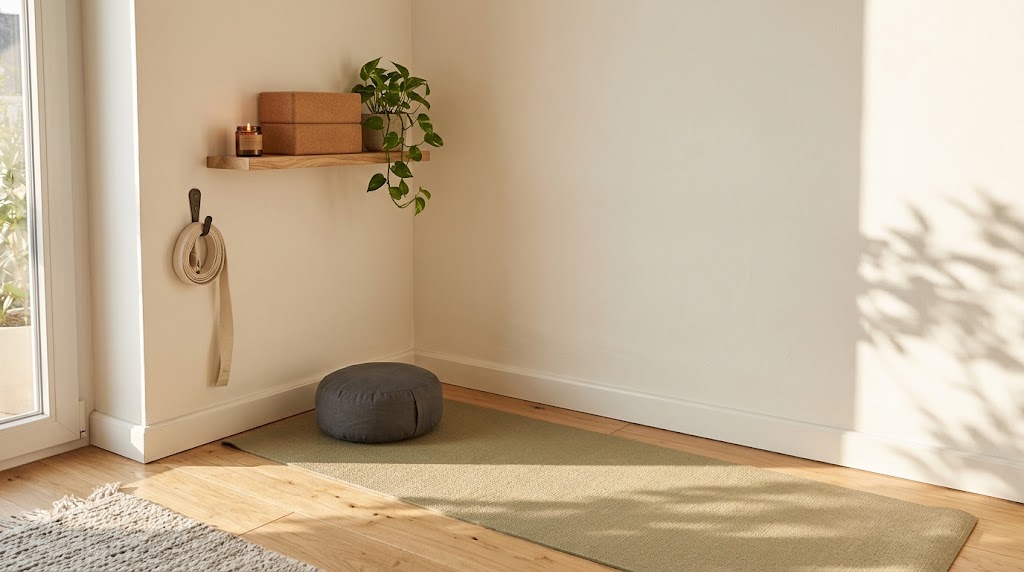
The biggest barrier to consistent home yoga is not motivation, money, or ability. It is setup friction. If you have to move a coffee table, clear a pile of laundry, and dig your mat out of a cupboard every time you want to practice, you will skip more sessions than you complete. The solution is a dedicated yoga corner: a permanent spot where your mat is always ready and your props are within arm's reach. And you need less space than you think.
How Much Space Do You Actually Need?
A standard yoga mat is 183cm by 61cm (6 feet by 2 feet). That is 1.1 square metres. Add 30cm of clearance on each side for arms in standing poses, and you need a rectangle roughly 183cm by 120cm, which is 2.2 square metres. But here is the thing: if your mat sits along a wall, you only need clearance on three sides. That brings it down to about 1.8 square metres.
For reference, that is smaller than a single bed. It fits in a bedroom corner, along a hallway wall, next to a couch, or in any gap between furniture that you can walk through. If you can stand in a spot with your arms at your sides and take one step forward, you have enough room for yoga.
Choosing the Right Spot
Not all 2-square-metre patches are equal. Here is what makes a good yoga corner:
- Hard floor preferred. Carpet is usable but makes balance poses harder because the surface compresses. If your best spot is carpeted, use a firm, thin mat (4mm to 6mm) so you are closer to the solid floor underneath.
- Near a wall. The wall serves double duty: storage (hooks, shelves) and balance support (for wall-assisted poses when you need them). It also means one fewer side that needs clearance.
- Away from foot traffic. If your mat sits in a walkway, it will get stepped on, moved, and eventually stored "just temporarily." A corner or alcove works best.
- Natural light if possible. Not essential, but a spot near a window makes morning practice noticeably more pleasant. Even a small window works.
The Mat: Leave It Down
The single most effective change you can make for consistency is leaving your mat permanently unrolled in your yoga corner. This eliminates the biggest piece of setup friction. You walk to your corner and start. No rolling, no unrolling, no finding space.
For a mat that lives on the floor permanently, you want something durable and easy to clean. The Gruper Non-Slip Eco-Friendly Yoga Mat works well for this because the TPE surface wipes clean with a damp cloth and the dual-layer construction stays flat without curling at the edges over time. Some cheaper mats develop permanent curl from being stored unrolled, which is annoying when you step on a rising edge mid-pose.
If leaving a mat down is not an option (shared space, cleanliness concerns), the next best approach is a mat with a carrying strap that hangs from a hook on the wall at your yoga corner. One motion to take it down, one to hang it back up. The Amazon Basics Extra Thick Exercise Yoga Mat includes a carrying strap and weighs under a kilogram, making the hook-and-hang method practical.
Prop Storage That Uses Zero Floor Space
Your yoga props need to be visible and accessible, not buried in a drawer. The moment they go into storage, you stop using them. Here are the space-saving solutions that work in a 2-square-metre corner:
Wall-Mounted Hooks
Two adhesive hooks (the damage-free kind that comes off cleanly) at shoulder height hold a rolled mat and a yoga strap. Total wall space: about 30cm. No drilling, no landlord issues, no permanent marks.
Small Floating Shelf
A single shelf (30cm by 15cm is plenty) at waist height holds two yoga blocks and a small candle or timer. The Gaiam Yoga Block is 9 by 6 by 4 inches, so two blocks stacked use a footprint of about 23cm by 15cm. That fits on the smallest shelf you can find.
Corner Basket
A small woven basket on the floor in the corner holds a bolster, a yoga wheel, and any overflow. If you use a Retrospec Sedona Meditation Cushion, it sits neatly on top of the basket as a visual anchor for the space. The cushion doubles as a comfortable floor seat when you are not using it for yoga, which means it earns its keep even on rest days.
The Complete Yoga Corner Kit
Here is everything you need, with approximate prices:
| Item | Pick | Price | Storage |
|---|---|---|---|
| Yoga mat | Gruper Non-Slip Mat | $28 | Floor (permanent) or wall hook |
| Yoga blocks (2) | Trideer 2 Pack | $13 | Wall shelf |
| Strap | Syntus Block and Strap Set | $25 | Wall hook |
| Yoga wheel | NGT 13-Inch Wheel | $25 | Corner basket |
| Meditation cushion | Retrospec Sedona | $27 | On top of basket / floor |
Full setup total: roughly $118. That is the price of about 6 to 8 drop-in studio classes, and you will have it for years.
If you are on a tighter budget, the essential starting point is just the mat and two blocks ($41). Add the strap, wheel, and cushion over time as your practice develops and you discover which styles you gravitate toward.
Making the Corner Feel Like a Space
This is optional but surprisingly effective for habit formation. When your yoga corner looks and feels different from the rest of the room, your brain associates it with practice rather than just "that corner by the window." A few low-cost touches:
- A small plant on the shelf next to your blocks.
- A battery-operated candle (no fire risk, no wax drips) for evening practice.
- A phone stand at mat height so you can follow video classes without holding your phone.
None of this is necessary. But the psychology of a designated space is real: people who have a visible, ready-to-use exercise area are significantly more consistent than those who set up and tear down each session. The yoga corner is not about aesthetics. It is about removing every possible excuse between you and your mat.
Bottom Line
You need 1.8 to 2.2 square metres, a mat, two blocks, and a wall with a hook. That is the minimum viable yoga corner. Everything else (wheel, bolster, cushion, candle, plant) is a nice addition that you layer in as your practice grows. The total cost starts at $41 and tops out around $120 for a comprehensive setup. The real investment is the decision to claim that corner and leave your mat there. Once you do, showing up becomes the easy part.
As an Amazon Associate, I earn from qualifying purchases at no extra cost to you, which helps keep this site running.