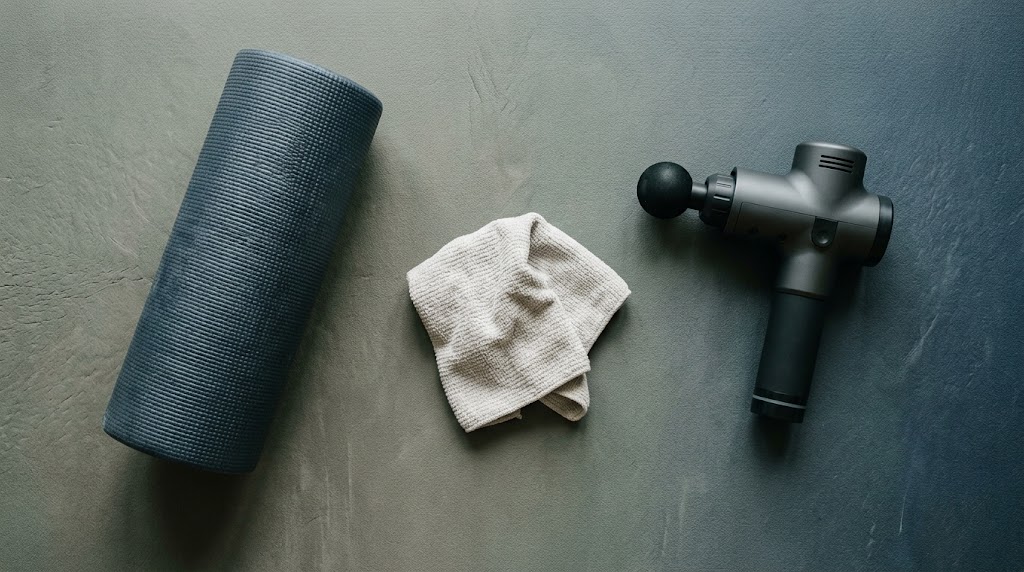
How they work differently
A foam roller uses your bodyweight and gravity to apply broad pressure across large muscle groups. You place the roller on the floor, position a muscle group on top of it, and roll back and forth. The pressure is distributed across a wide surface area, which makes it effective for general myofascial release and improving blood flow to large areas.
A massage gun (percussive therapy device) delivers rapid, concentrated pulses to a specific point. You hold it against a muscle and it hammers the tissue at 1,400 to 3,200 percussions per minute depending on the speed setting. The pressure is localised, which makes it better for targeting specific trigger points and knots.
Neither is inherently better. They solve different problems.
Head to head comparison
| Factor | Foam Roller | Massage Gun |
|---|---|---|
| Pressure type | Broad, bodyweight-driven | Localised, percussive |
| Best for | Large muscle groups (quads, back, IT band) | Specific trigger points (traps, calves, glutes) |
| Ease of use | Floor required, some positions awkward | Handheld, easy to reach most areas |
| Time per session | 10 to 15 minutes | 5 to 10 minutes |
| Noise | Silent | Moderate (40 to 70 dB depending on model) |
| Price | $15 to $50 | $80 to $400 |
| Portability | Bulky (18 to 36 inches long) | Compact, fits in a bag |
| Power source | None | Rechargeable battery |
| Durability | Years (no moving parts) | 2 to 5 years (battery and motor) |
When a foam roller wins
Pre-workout warm up
Rolling large muscle groups for 2 to 3 minutes before training increases blood flow and temporarily improves range of motion. A systematic review in the Journal of Sports Science & Medicine found that foam rolling before exercise improved flexibility without reducing strength output, which is something static stretching cannot claim.
The high-density foam roller is firm enough to create meaningful pressure but forgiving enough that you can use it daily without bruising. It is the standard choice for most home gym users.
Large muscle group recovery
After a heavy leg day, foam rolling your quads, hamstrings, and IT band moves blood through the tissue and reduces the severity of delayed onset muscle soreness (DOMS). The broad pressure covers the entire muscle in a way that a massage gun's small head cannot replicate efficiently.
Budget-conscious buyers
A quality foam roller costs $15 to $30 and lasts for years. There is no battery to die, no motor to burn out, and no moving parts to fail. If you are building a home gym on a budget, the foam roller gives you recovery benefits at a fraction of the cost.
When a massage gun wins
Targeted trigger points
A knot in your upper trap, a tight spot in your calf, or a stubborn adhesion in your glute responds better to concentrated percussive therapy than broad rolling. The massage gun's small head delivers force directly to the problem area with precision that a cylindrical foam roller cannot match.
The Theragun Mini is the most portable option from the brand that popularised massage guns. It fits in one hand, has three speed settings, and weighs under 1.5 lbs. The compact size makes it easy to reach areas like the neck, shoulders, and forearms that are difficult to foam roll.
For a more powerful option with multiple head attachments, the Theragun Prime provides deeper percussive therapy with a quieter motor and longer battery life. The flat, bullet, and dampener heads let you adapt the treatment to different muscle groups and sensitivity levels.
Hard to reach areas
Foam rolling your upper back, neck, and shoulders requires contorting yourself on the floor in positions that are awkward at best and counterproductive at worst. A massage gun reaches those areas while you sit in a chair.
Speed and convenience
A full-body massage gun session takes 5 to 8 minutes. A full-body foam rolling session takes 12 to 15 minutes. If time is the constraint (and for most people it is), the massage gun fits into a busy schedule more easily.
What about vibrating foam rollers?
Vibrating foam rollers combine both approaches: broad surface pressure with built-in vibration motors. Research suggests they may provide slightly better pain reduction than standard foam rollers, but the evidence is limited and the price ($60 to $150) puts them in the same range as entry-level massage guns. For most people, a standard foam roller plus a massage gun is a more versatile combination than a single vibrating roller.
The smart answer: use both
This is not a cop out. The two tools genuinely complement each other.
- Before training: Foam roll the major muscle groups you are about to work. This takes 3 to 5 minutes and improves range of motion for your working sets.
- After training: Use the massage gun on any areas that feel tight or knotted. Focus on the muscles you trained hardest. This takes 3 to 5 minutes.
- Rest days: A full-body foam rolling session (10 to 15 minutes) maintains mobility and accelerates recovery between training sessions.
The total cost for a quality foam roller and a Theragun Mini is under $130. That is less than a single sports massage and you can use both tools every day for years.
Track how your recovery improves over time with a Fitbit Charge 6. Monitoring your resting heart rate trend and sleep quality gives you objective data on whether your recovery routine is working, rather than going by feel alone.
If you can only buy one
Get the foam roller first. It is cheaper, requires no power, works for both warm up and recovery, and covers the majority of recovery needs for most home gym users. Add a massage gun later when your budget allows and you have identified specific trigger points that the foam roller does not address.