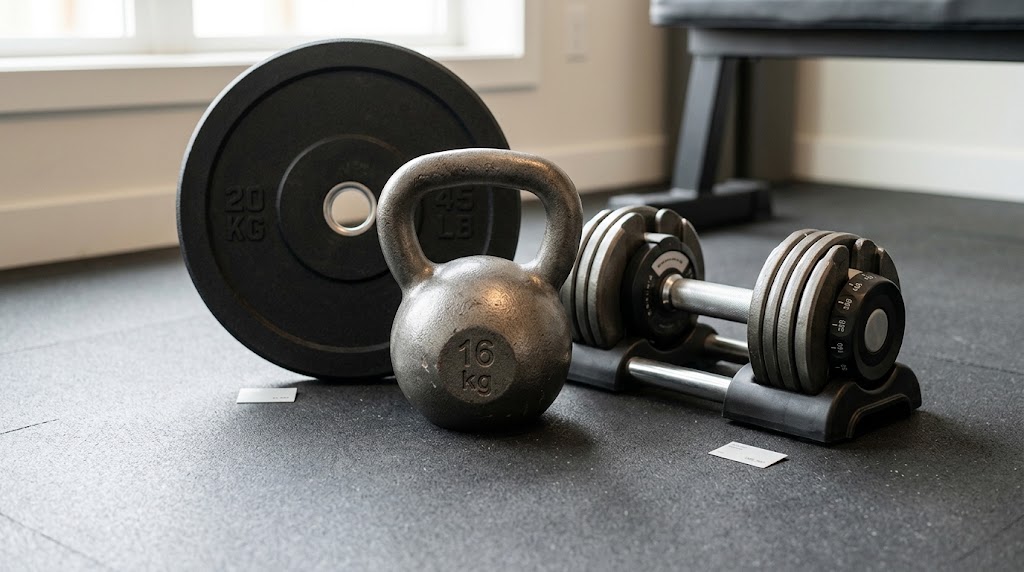
Why resale value matters
Most people calculate the cost of home gym equipment as the purchase price. That is the wrong way to think about it. The real cost is the purchase price minus the resale value, divided by the months you used it.
Example: You buy a set of dumbbells for $300, use them for two years, and sell them for $240. Your actual cost was $60 over 24 months, or $2.50 per month. That is cheaper than a single day pass at most commercial gyms.
Equipment that holds its value turns your home gym from an expense into something closer to a rental arrangement. You pay for the use, not the object.
Equipment that holds value well
Cast iron and steel weights
Iron does not wear out. A cast iron dumbbell from 1985 performs identically to one manufactured yesterday. This makes iron weights the gold standard for resale value in the fitness equipment market.
Used iron weights typically sell for $0.50 to $0.75 per pound on local marketplaces. New iron weights retail for $1.00 to $1.50 per pound. That means a set of iron dumbbells retains 50 to 75% of its retail value indefinitely, with no depreciation over time. During periods of high demand (like early 2020), used iron weights actually sold for more than their original retail price.
Adjustable dumbbells (name brand)
Name-brand adjustable dumbbells hold value well because demand consistently exceeds supply on the secondhand market. The Bowflex SelectTech 552 retails for roughly $350 to $400 and typically sells used for $250 to $300 in good condition. That is a 65 to 75% retention rate.
The key factor is brand recognition. Buyers searching for used adjustable dumbbells search for "Bowflex" or "PowerBlock" by name. Generic adjustable dumbbells from unknown brands lose significantly more value because nobody is searching for them.
Barbells (mid-range and above)
A quality Olympic barbell is another near-permanent purchase. Rogue, Rep Fitness, and Titan barbells in the $200 to $400 range hold 60 to 80% of their retail value used. The barbell itself has no electronics, no moving parts, and very little that can go wrong. A light coat of oil every few months keeps it functioning indefinitely.
Kettlebells
Cast iron kettlebells follow the same pattern as dumbbells. Iron is iron. A 35 lb kettlebell works the same whether it is new or ten years old. Expect to recover 60 to 70% of your purchase price on the secondhand market. Competition kettlebells (standardised size regardless of weight) hold slightly more value because they serve a niche audience willing to pay a premium.
Equipment that loses value fast
Treadmills
Treadmills are the worst-performing category for resale value. A $1,500 treadmill typically sells used for $300 to $500 within two years, representing a 65 to 80% loss. The reasons are practical: treadmills are heavy (150 to 300 lbs), difficult to transport, take up significant floor space, and buyers worry about motor and belt wear. Every listing competes with hundreds of other used treadmills from people who bought one in January and stopped using it by March.
Budget equipment from unknown brands
A $40 dumbbell set from an unknown Amazon marketplace seller has near-zero resale value. Nobody searches for the brand, the quality is suspect, and the buyer pool is limited to people who want the cheapest possible option. Those people are already buying the same $40 set new.
Connected fitness equipment (with subscriptions)
Equipment that requires a subscription to unlock its primary features loses value quickly because the buyer inherits an ongoing monthly cost. A Peloton bike that retailed for $1,500 plus $44 per month typically sells used for $400 to $600. The subscription dependency makes it less attractive to secondhand buyers who want equipment, not another monthly bill.
Massage guns
Massage guns depreciate quickly because the technology improves year over year, new models launch constantly, and buyers worry about battery degradation. A $300 massage gun from two years ago competes with a better $150 massage gun on sale today. Expect to recover 30 to 40% of the purchase price.
Resale value summary
| Equipment | Typical Resale (%) | Why |
|---|---|---|
| Cast iron weights | 60 to 80% | Iron is permanent, always in demand |
| Name-brand adjustable dumbbells | 65 to 75% | Brand recognition, consistent demand |
| Olympic barbells (mid-range) | 60 to 80% | No moving parts, lasts forever |
| Kettlebells | 60 to 70% | Same as cast iron weights |
| Pull up bars | 50 to 60% | Simple, durable, universal fit |
| Resistance bands | Near zero | Cheap new, hygiene concerns used |
| Yoga mats / foam rollers | Near zero | Hygiene, cheap to replace |
| Budget treadmills | 20 to 35% | Heavy, hard to move, motor wear |
| Connected fitness bikes | 30 to 40% | Subscription dependency, market flooded |
| Massage guns | 30 to 40% | Tech obsolescence, battery concerns |
How to maximise resale value
- Keep the original packaging. Equipment with its original box sells for 10 to 15% more because it signals that the owner took care of it and makes shipping easier.
- Buy name brands. The Bowflex SelectTech 552 costs more upfront than a generic adjustable dumbbell, but it holds $200+ of resale value that the generic version never had.
- Maintain your equipment. Wipe down after every use, oil barbell sleeves quarterly, store indoors. Rust and visible wear reduce resale price by 20 to 30%.
- Sell locally. Facebook Marketplace and Craigslist avoid shipping costs, which eat into proceeds on heavy items. Gym equipment is heavy. Local sales are always better.
- Sell at the right time. January (New Year's resolutions) and September (back to routine after summer) are peak demand periods for used gym equipment. Listing during these months can add 10 to 20% to your selling price.
The bottom line
The smartest home gym purchases are the simplest ones. Cast iron, steel, and name-brand adjustable systems hold their value because they are durable, in demand, and not dependent on technology that changes yearly. When you factor in resale value, a $400 set of Bowflex dumbbells that you sell for $280 after two years cost you $5 per month. That is the real price of home gym ownership.