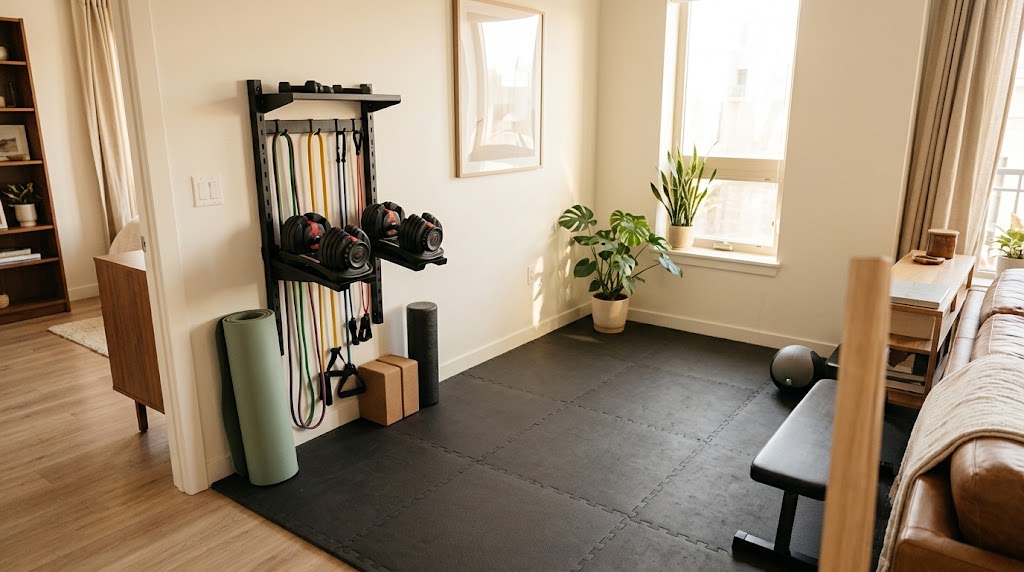
Start with the floor, not the equipment
Most people shopping for a home gym start by looking at dumbbells or treadmills. That is backwards. If you live in an apartment, the first thing to sort out is what goes between your equipment and your floor. Get that wrong and you are dealing with scratched hardwood, noise complaints, and gear sliding around mid-set.
A set of BalanceFrom interlocking foam tiles covers 24 square feet for under $30. They protect your floor, absorb noise, and give you a defined workout zone you can set up and tear down in minutes. If you are planning to use heavier equipment like adjustable dumbbells on a rack, a rolled rubber gym mat from IncStores is more durable and will not compress under load the way foam does.
If you are on an upper floor, consider adding an IncStores rubber underlayment layer beneath your main flooring. It is designed to reduce impact noise that travels to the apartment below, and the difference is noticeable.
Choose equipment that folds, stacks, or hangs
The fundamental challenge of apartment fitness is that your gym shares space with the rest of your life. The solution is gear that disappears when you are done with it.
A pair of Bowflex SelectTech 552 adjustable dumbbells replaces 15 pairs of individual dumbbells. They sit in a cradle that takes up about as much space as a shoebox on the floor. Pair them with a FLYBIRD foldable weight bench that folds down to roughly 17 by 16 by 9 inches, and you have a serious strength station that tucks into a closet when guests come over.
For the same reason, a doorway pull-up bar like the Ally Peaks doorway bar beats a freestanding power tower. It lifts off in seconds and leans against a wall or hangs in a closet.
Organise from day one
Small gear multiplies fast: resistance bands, jump ropes, yoga blocks, grip trainers. Without a plan, they end up scattered across the apartment.
A wall-mounted equipment storage rack takes up zero floor space and keeps everything visible and accessible. A Trail maker 55L duffle bag is a cheaper alternative if you do not want to put holes in the wall. Everything goes in the bag, the bag goes in the closet. Done.
If you are building up a dumbbell collection (neoprene sets for lighter work alongside your adjustable pair), a CAP Barbell A-frame dumbbell rack keeps them upright in less space than a kitchen chair.
A starter shopping list that actually makes sense
You do not need everything at once. Here is a practical order of priority:
- Floor protection (foam tiles or rubber mat). Without it, everything else risks damage to your apartment.
- Adjustable dumbbells. The single most versatile piece of compact gym equipment.
- A foldable bench. Opens up dozens of exercises you cannot do standing.
- A pull-up bar or resistance bands. Covers the pulling movements that dumbbells alone miss.
- Storage solution. Wall rack, duffle bag, or dumbbell stand. Keep it tidy or you will stop using it.
You can build a fully functional apartment gym for under $600 following this sequence. Add a walking pad or stepper later if cardio is a priority (see our quiet cardio guide).
Common mistakes to avoid
Buying too much at once is the most common error. People order a bench, dumbbells, a rower, a yoga mat, bands, and a foam roller in one go, then realise they do not have room to use half of it. Start with the basics, use them for a month, and add equipment based on what your training actually needs.
The second mistake is ignoring noise. If you live above someone, dropping dumbbells on foam tiles still makes noise. Controlled lowering, rubber flooring, and choosing magnetic resistance cardio equipment (instead of fan or water resistance) will keep your neighbours happy and your home gym sustainable long term.
Make it a space you want to use
The best home gym setup is the one you actually use. A clear, organised workout area, even if it is just a 6 by 4 foot patch of floor tiles in the corner of your living room, signals to your brain that it is time to train. A cluttered pile of equipment shoved behind the sofa does not.
Treat your home gym like a room within a room. Floor it properly, store your gear visibly, and keep it ready. The setup should take less than two minutes. If it takes longer, you will skip workouts.