HIIT in an apartment: the rules
High-intensity interval training works by alternating short bursts of intense effort with brief rest periods. It is one of the most time-efficient ways to improve cardiovascular fitness and burn calories. The problem in an apartment is that the most common HIIT exercises (burpees, jump squats, box jumps) create impact noise that will have your downstairs neighbour knocking on the ceiling.
The solution is not to avoid HIIT. It is to choose low-impact, high-effort exercises that drive your heart rate up without your feet leaving the floor.
Equipment for apartment HIIT
You do not need much, but a few pieces make the workouts significantly better:
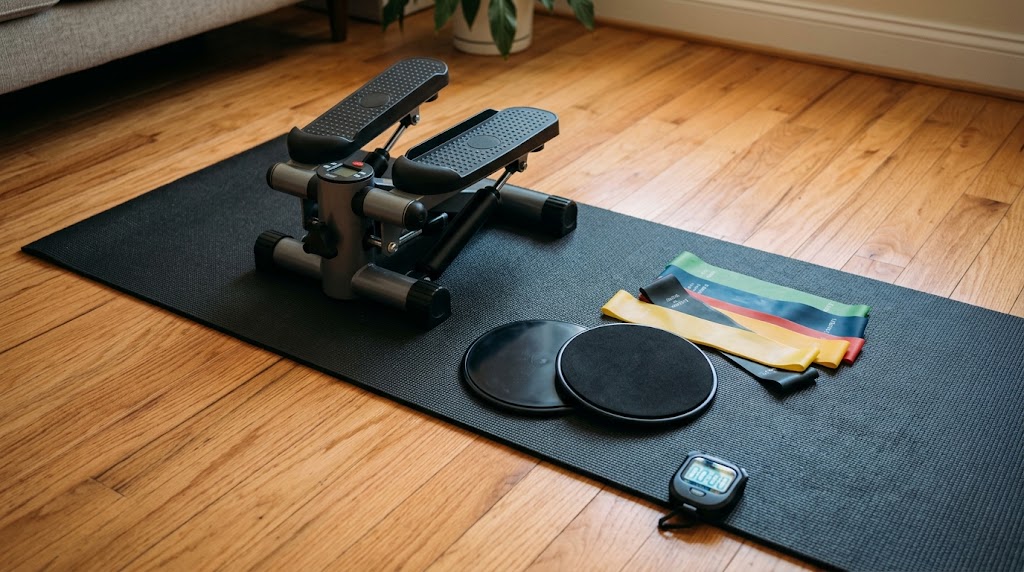
- Sunny Health mini stepper: A low-impact step machine that fits under a desk. High-speed stepping drives your heart rate up fast without impact noise. The hydraulic cylinders are quiet enough for apartment use.
- Synergee core sliders: On a hard floor, sliders let you do mountain climbers, lateral lunges, pike slides, and hamstring curls at high speed with zero impact. These are a genuine apartment HIIT secret weapon.
- Fit Simplify resistance loop bands: Add resistance to bodyweight movements without adding noise. Banded squats, lateral walks, and banded push-ups increase intensity without impact.
- Gymboss interval timer: Clip it to your waistband and let it handle the timing. Fumbling with a phone app mid-workout is a distraction you do not need when you are working at high intensity.
The 20-minute apartment HIIT workout
Format: 40 seconds of work, 20 seconds of rest. Five exercises, four rounds. Total time including warm-up and cool-down: about 20 minutes.
Warm-up (3 minutes)
March in place for 60 seconds. Arm circles forward and backward for 30 seconds. Bodyweight squats for 60 seconds. Leg swings (holding a wall) for 30 seconds.
The circuit
1. Speed stepper intervals: Step as fast as you can on the mini stepper for 40 seconds. The key is driving through your heels and pumping your arms. This spikes your heart rate immediately.
2. Slider mountain climbers: Hands on the floor, feet on core sliders. Drive knees toward your chest alternately as fast as you can control. The sliders eliminate the foot-strike noise of regular mountain climbers while making the movement harder because you have to control the slide.
3. Banded squat pulses: Place a loop band above your knees. Squat to parallel and pulse at the bottom (small up-and-down movements) for 40 seconds. The band forces your glutes to stay engaged throughout. No jumping, no impact.
4. Slider pike to push-up: Feet on sliders, hands on floor. Slide your feet toward your hands, lifting your hips into a pike position, then slide back out and do a push-up. Repeat for 40 seconds. This hits shoulders, chest, and core in one movement.
5. Standing band pull-aparts: Hold a loop band in front of you at chest height. Pull it apart until your hands are at your sides, squeezing your shoulder blades together. Fast controlled reps for 40 seconds. This is your active recovery round while keeping your heart rate up.
Rest 60 seconds between rounds. Complete four rounds total.
Cool-down (2 minutes)
Walk slowly around your apartment for 60 seconds. Stretch your quads (standing, pull heel to glutes) for 15 seconds per side. Stretch your chest (doorway stretch) for 15 seconds per side.
Protecting your floor
Slider exercises require a smooth, hard surface. If your workout area is carpeted, flip the sliders to the smooth side. For floor protection during stepper use, place the stepper on a set of rubber gym tiles to prevent marks and absorb any vibration.
Scaling the workout
If four rounds feels too ambitious at first, start with two or three. Add a round each week until you reach four. To make individual exercises harder, use a thicker resistance band, increase the stepper resistance, or slow the eccentric (lowering) phase of each movement.
The 40/20 work-to-rest ratio is a solid starting point. As your conditioning improves, you can shift to 45/15 or even 50/10 for a more demanding session. The Gymboss timer makes switching intervals effortless.